Skip to content

Thenman, Kristine

Country:

Sweden

Description:

Kristine grew up in Edane. She lived elsewhere for a few years while she studied ceramics and then returned to work with ceramics. She has studied ceramics at art colleges in both Bergen, Norway, and in Gothenburg, as well as at folk high schools. She has her own studio and workshop near her home (walking distance). She works with ceramics full-time and mainly with modeling, hand building, rolling/slab and turning. She has about two exhibitions per year, is a member of a craft collective in Arvika. Sells her objects at retailers, in her webshop and at Arvika konsthantverk.


Relation to the area

native

Kristine grew up in Edane. She lived in another city when studying ceramics, but then returned to work as an artisan.

Title Description Type

Occupation

ceramics

Type of involvement

full-time paid job

Inventory ID:

RV_PR_05

Author of the entry:

Ulrika Jäger, Kajsa Stinnerbom

Start Date of Existence:

1981?

Gender:

female

Language:

Swedish

Bio:

Kristine grew up in Edane. She lived elsewhere for a few years while she studied ceramics and then returned to work with ceramics. She has studied ceramics at art colleges in both Bergen, Norway, and in Gothenburg, as well as at folk high schools. She has her own studio and workshop near her home (walking distance). She works with ceramics full-time and mainly with modeling, hand building, rolling/slab and turning. She has about two exhibitions per year, is a member of a craft collective in Arvika. Sells her objects at retailers, in her webshop and at Arvika konsthantverk.

Social Media:

facebook instagram

E-Mail:

kristine.thenman@gmail.com

Phone:

46738273873


Knowledge and skills

What knowledge and skills are essential for the practitioner to engage with the cultural practice?

To know processes and techniques from clay to finished product. Different clays, glazes, firing, shape and pattern creation. Which tools are used when and for what. Thenman, together with another ceramicist (Joel Stuart Beck) in the area, has dug up and used clay from the area.

How did the practitioner acquire those knowledge and skills?

Course for Ian Hagard, Skutboudden. High school: aestetic field, Solberga. Folk high school in Grebbestad 1 year, throwing. Kuben, 1 år in Gothenburg. 2007 Magister's degree in applied arts, ceramic art, HDK, School of Design and Crafts, Gothenburg. 2005 Bachelor, section for ceramics, Bergen Academy of the Arts, Norway.

Does the practitioner teach anyone the skills they possess? Who? How?

Thenman sometimes teaches ceramics students at folk high schools. She has had a few courses in her workshop. Artisan Joel Stuart Beck and Thenamn have had an exhibition at the Rackstad Museum where they talked about their work. She has a lot of study visits from classes when she shows how she does it. Folk high schools: Kyrkerud, Mullsjö, Bordinge By, Ingesund. About 11 minutes into the interview.

Material

What materials does the practitioner use?

Clay and glaze

Where does the practitioner get materials from?

She buys most of her supplies from a retailer in Kil, Värmland who buys from www.cebex.se. It's easy for her to buy there, cebex has a kind of monopoly on the kind of material she needs.

How does the practitioner manage leftovers?

Sludge is collected through the slush in a special barrel. Broken pottery becomes pottery again.

Production

What techniques does the practitioner use?

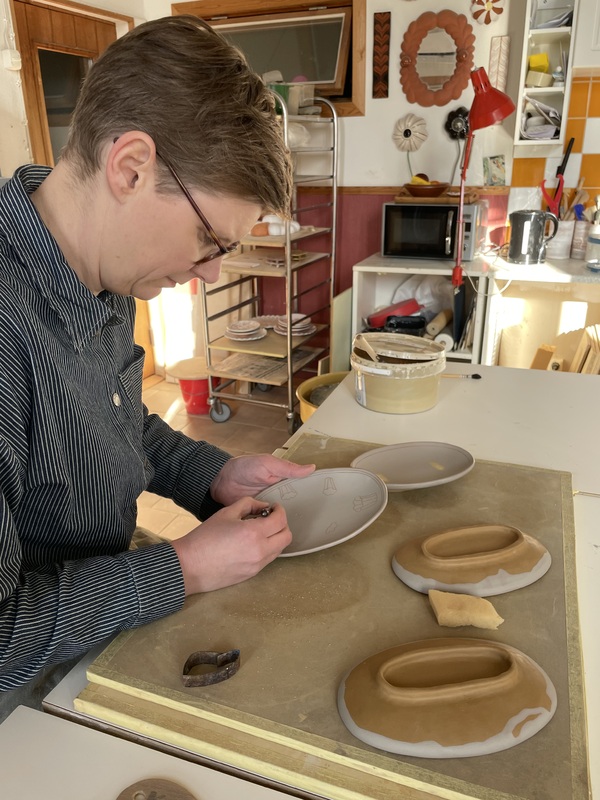
Modeling, hand building, rolling/slab, turning, printing mold (making your own shapes in plaster), sgraffito, turning.

What tools does the practitioner use?

Pottery wheel, sgraffito tool, sponge, saw blade, metal band/scraper tool (pictured in "tools").

What are the practitioner’s relations with the tools they use? What meaning do the tools they use have to them?

She made the saw blades herself and she has a lathe that she has had since high school.

What sources of energy does the practitioner use?

She rents her studio, heated with electricity.

What waste is generated during production? How is it managed?

Sludge is collected in a special barrel.

Workshop

Does the practitioner have a separate workshop/work space/etc.? Describe where it is located and what it is it like.

Thenman is within walking distance of her workshop, which is located in Edane. Her father previously owned the premises (wood processing in a sawmill, they made moldings and other things) which is now owned by her brother. She rents the premises from her brother. There is a large veranda at the entrance, high ceilings and large windows with lots of light. There is a large garage wall to wall where there is winter storage for e.g. caravans, boats. She shares some spaces with that workshop.

Products and services

What kind of items does the practitioner produce?

Thenamn emphasizes that she does not make production ceramics or pottery in production. She makes unique objects.

For what purposes does the practitioner produce them?

It can be orders, design assignments, for sale, for exhibition.

If items are produced for sale, where are they being sold?

She sells in her own webshop, and other retailers, exhibitions, the co-op Arvika konsthantverk. Also, through the company "Fine Little Day" which markets her products.

What kind of services (if any) does the practitioner offer?

Orders, courses, lectures, design assignments, exhibitions.

Does the practitioner provide repair/utilisation services?

On one occasion there was a two-year warranty (large wall decoration sold to the government office where two parts had come loose). Otherwise no.

Who are the practitioner’s customers (both products and services)?

See her website for who are the purchasers, in addition to private individuals, of her ceramics and services: regions, the state, municipalities and other public administrations.

Do the practitioner’s products/services have any certification/labels (e.g., place of origin, bio, organic, handmade, heritage product, etc.)? If yes, what?

No, apart from being part of Arvika konsthantverkare.

Tourism

Is the practitioner engaged in activities related to tourism? What kind of activities? When do they take place? Who are the tourists (e.g., domestic, foreign)?

No. Nothing beyond sales at, for example, Arvika konsthantverkare.

Enter a direct quote from the interview (1-2 sentences) in the original language that reflects the practitioner’s feelings about the engagement with tourism (the quote should be potentially emotionally charged).

Jag ser inte hur jag ska kunna få.....alltså jag har...det jag gör säljer jag så jag har inget överskott av produkter så....då vet jag inte riktigt vad...Jag skulle kunna ha kurser för turister då. Men det har jag egentligen inte lust med för jag har inte tid för att jag ska göra de här produkterna som jag ändå säljer. Det går ihop tidsmässigt. Sen kanske det hade varit smart å jobba med turism å ha kurser för att man kunde få mer pengar för mindre tid så men det är ju inte där mitt intresse ligger. (cirka 27 min into the interview).

Partnership

Is the practitioner a member of any group/organisation? Are there any co-creation spaces/projects they are taking part in? Are they partnering with other practitioners? Are they collaborating with academia (researchers/research institutions, etc.)? Are they collaborating with public institutions (local government, museums, archives, schools, culture centres, etc.)?

Arvika konsthantverkare

Challenges

What are the challenges the practitioner encounters (can be related to the practice and its different aspects, life in a rural area in general, etc.)

She finds it challenging with society's view of what is important and her work is not seen as important. And certainly not today when culture is so undervalued. She finds that difficult. She sees a bright future for her in ceramics, there is an interest among people and people want to do it. It is difficult to get people to understand that ceramics take time to make and need to be priced accordingly.

Enter a direct quote from the interview (1-2 sentences) in the original language that reflects the practitioner’s feelings about the challenges they face (the quote should be potentially emotionally charged)

Jag tycker att den största utmaningen är att få det att gå ihop ekonomiskt, så är det ju. Och tiden då. Sen men sen kan jag rent sådär personligt brottas man ju lite med det här att känna sig ibland kan man känna som att man att man inte riktigt är en del av samhället att man liksom man att det man för inte är på riktigt så. Men det där går i vågor. Det psykiska måendet.

References

Add references to sources related to the practitioner (academic literature, secondary sources, media publications, museum and archival data, etc.). Add as many rows as necessary. One reference per row.

https://kristinethenman.se/
https://arvikakonsthantverk.se/medlemmar/kristine-thenman.html
https://finelittleday.com/artists/kristine-thenman/
https://sv.wikipedia.org/wiki/Kristine_Thenman


Entry Author:

iain

Date of entry:

2025-09-02T09:17:18+00:00