Skip to content

Fernández Martínez, Marta

Country:

Spain

Description:

Marta Fernández Martínez was born in the village of Ambás (municipality of Grau/Grado, Asturias) on October 29, 1979. A daughter of a farming family, her childhood unfolded in the rural Asturian environment, contributing to the domestic tasks of a family farm dedicated to dairy production and cheese-making. She studied Forest Engineering at the University of Oviedo, working as such for several years on various forestry and environmental projects throughout Asturias. In 2011, after being unemployed for a few months, she decided to join her parents' family business, Filomena Martínez and José Antonio Fernández, Queisos Ca Sanchu. Nowadays, she has moved back to her hometown and runs the cheese factory together with her partner, Xel.
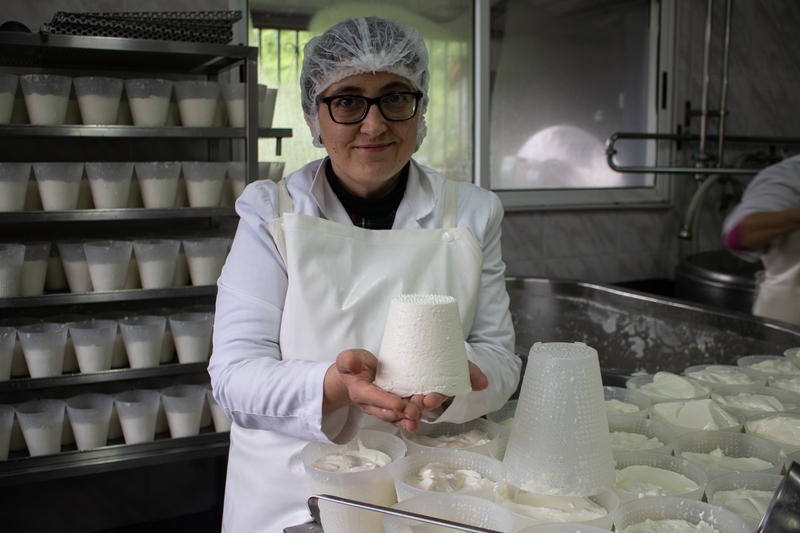
Her full-time dedication is the small family business, her cheese factory specializing in Afuega’l Pitu cheese.


Relation to the area

native

Title Description Type

Type of involvement

full-time paid job

Inventory ID:

UNIOVI_PR_02

Author of the entry:

Santiago Rodríguez Pérez, Llara Fuente Corripio

Start Date of Existence:

1979

Gender:

female

Language:

Asturian,Spanish

Bio:

Marta Fernández Martínez was born in the village of Ambás (municipality of Grau/Grado, Asturias) on October 29, 1979. A daughter of a farming family, her childhood unfolded in the rural Asturian environment, contributing to the domestic tasks of a family farm dedicated to dairy production and cheese-making. She studied Forest Engineering at the University of Oviedo, working as such for several years on various forestry and environmental projects throughout Asturias. In 2011, after being unemployed for a few months, she decided to join her parents' family business, Filomena Martínez and José Antonio Fernández, Queisos Ca Sanchu. Nowadays, she has moved back to her hometown and runs the cheese factory together with her partner, Xel.

Her full-time dedication is the small family business, her cheese factory specializing in Afuega’l Pitu cheese.

Social Media:

facebook instagram

E-Mail:

queseriacasanchu@gmail.com

Phone:

985 752 222


Knowledge and skills

What knowledge and skills are essential for the practitioner to engage with the cultural practice?

Marta believes that great skill is not required to make cheese, as it is a relatively simple technical process. For her, sensitivity and awareness regarding the product being created are far more important. She does not consider it essential to have acquired the knowledge in the home where the artisan was born or to have a family tradition in the craft. In her opinion, the key is to show respect for tradition, for the generations who preserved and transmitted it, and for the production of the product in line with traditional methods.

For example, the simple gesture of using the 'garciella' (ladle) to pour the cheese into molds and fill them slowly, instead of using a larger spoon or a machine to automate the process, already reflects specific qualities of the cheese and respect for its traditional production. Making it differently, in a way that does not respect traditional methods, may result in a similar product but detracts from the authenticity and attributes of the final product. According to Marta, this production method gives the cheese unique characteristics that must be protected.

This issue is of great importance to the artisan. Nowadays, technological innovations even allow for modifying or adapting the flavors of cheese for different audiences through the use of flavorings, or removing the natural molds of the cheese (such as geotrichum candidum) using anti-mold products. While these practices might make the cheese more marketable, they would compromise the essence of Afuega’l Pitu cheese, which is defined by its unique characteristics. Marta believes that the product must remain true to its original nature. In fact, it is possible to clearly distinguish a cheese made according to traditional methods from one that does not follow these practices

How did the practitioner acquire those knowledge and skills?

Marta learned to make cheese from her mother at the family home and also from her grandmother in the nearby village of Cubia. Cheese had always been an integral part of her family traditions, and she views the transmission of this knowledge as something natural, a genuine family legacy. From a very young age, she became familiar with the cheese-making process. Cheese production was a family activity in which even the children participated, contributing to the various tasks involved in its creation.

Does the practitioner teach anyone the skills they possess? Who? How?

Marta has conducted workshops on dairy products, especially butter and cheese, aimed at students from various schools in the area. These workshops are part of educational programs designed for primary and secondary school students, where the basic processes of making butter and cheese are taught, allowing participants to create their own product. She has not provided formal training, specific courses for professionals, nor has she ever had an apprentice

Material

What materials does the practitioner use?

The main ingredient for making cheese is cow’s milk. Additionally, rennet is used in small amounts to carry out the milk coagulation process. No other products, such as anti-mold agents, are used, allowing the cheese to naturally develop its characteristic molds. Furthermore, plastic is used for packaging, along with labels.

Where does the practitioner get materials from?

The milk comes from local farms located in villages near the cheese factory (Llamas, Santianes de Molenes), where the cows are raised grazing freely outdoors. In the past, her family had their own dairy farm dedicated to milk production. Part of that production was used to make cheese in the family business, while the other part was collected by a dairy cooperative.

Currently, obtaining high-quality locally produced milk is challenging. Small dairy farms in the area are disappearing. Farmers prefer to produce beef cattle because these animals require less work than dairy farming, which demands complete dependence. Dairy farms are not profitable if they have few heads of livestock, and in the mid-mountain area where the homestead is located, it is not feasible to establish large-scale dairy farms. However, within the Protected Designation of Origin lies the municipality of Tinéu, a major dairy production center and one of the municipalities that produces the most milk in all of Spain.

Nevertheless, their cheese production relies on dairy farming. Livestock farms are increasingly larger, and it could happen that they no longer supply small cheesemakers, focusing only on large cooperatives and distributors. Unfortunately, small farms that exclusively provide milk to small cheese factories are not viable, as the amount produced is too small to be profitable.
Milk is purchased from dairy centers, not directly from farmers. However, they are aware of the milk’s origin because the central's truck first collects the milk from producers and then delivers a portion to the cheese factory. If they decided to make direct purchases, they would need their own truck. The possibility of having a small dairy farm has also been considered, but this would require completely rethinking their model. Producing their own milk would be a challenging endeavor.

How does the practitioner manage leftovers?

The cheese factory produces hardly any cheese remnants or byproducts. All the milk received is fully processed into cheese. No surpluses are generated that require management.

Production

What techniques does the practitioner use?

The milk delivered to the cheese factory is stored in an outdoor tank at temperatures below 4 degrees Celsius. The following morning, it is pasteurized using a pasteurizer, subjecting it to 72 degrees Celsius for 5 seconds, which eliminates bacteria and microorganisms. Subsequently, the pasteurizer pours the milk into curdling vats, where it is maintained at an average temperature of 27-28 degrees Celsius, ideal for producing this type of cheese.

Once in the vats, the milk is left for 3 to 4 hours to allow its pH to drop to a level of 4.5-5. Afterward, rennet is added. Originally, the rennet was of animal origin, though nowadays it is produced in laboratories. The amount used is 45 milliliters of rennet per 1,000 liters of milk, representing a very small quantity.

Traditionally, in the production of afuega’l pitu cheese, two processes can be followed, historically documented and related to the curdling process. It is possible to curdle without rennet by utilizing temperature differences and pH reduction. However, the issue with this curd, known in Asturian as leche presa, is that it has much less consistency. If poured into a mold with holes (barreña), the curd escapes through the openings. For this reason, a piece of cloth (trapu) is used to strain the whey when pouring the curd.
If rennet is used, the curd gains greater consistency and can be directly placed into the barreñas to finish draining the whey. Rennet (cuayo in Asturian) is a digestive enzyme that enables milk coagulation, traditionally obtained from the stomach of ruminants. However, in the past, this enzyme was also extracted from the intestines of pigs, which were slaughtered at home for domestic consumption during the traditional pig-slaughtering (matanzas).

The curd of Afuega’l Pitu cheese is of an acid-lactic or mixed type, as the milk coagulates due to the pH reduction caused by acidity, with rennet aiding in the process. Once the milk is placed in the curdling vat, it is left to rest for 24 hours, ensuring the temperature remains constant and avoiding significant fluctuations. Nowadays, this process is carried out in a vat equipped with temperature control, which is maintained between 22 and 32 degrees Celsius.

Once the curd is prepared, it is poured into molds known as barreñas. For this, a garcilla (ladle) is used, which allows the curd to be placed in layers within the molds. The process is slow and labor-intensive, as the molds must be filled one by one, working in batches of more than 100 cheeses. Nowadays, the molds, which are conical in shape, are made of food-grade plastic. In them, the curd gradually drains the whey. The cheese remains in this draining process for 24 to 48 hours, without the need for pressing. The initial result is fresh, unsalted cheese, ready for commercialization. If salted cheese is desired, a small amount of salt is manually added to the fresh cheese after unmolding it. Approximately 100 liters of milk yield around 40 cheeses, with each cheese requiring between 2.2 and 2.5 liters of milk.

From this point, the processes vary depending on the type of cheese. For the Atroncáu blancu variety, the cheeses are kept in the maturation chamber for a maximum period of 20 days. The cheese maintains its conical shape and characteristic white color.

In the case of Atroncáu roxu, after 24 hours of whey drainage in the barreñas, the cheeses are kneaded. For this, the fresh cheeses are placed in a kneader, where salt and paprika are added. During the kneading process, both ingredients are evenly distributed throughout the mixture. The mixture is then placed into molds using a gauze to prevent it from sticking to the mold walls. The cheese remains in the molds for one day, after which it is unmolded and transferred to the maturation chamber. Its distinctive color is reddish-orange.

The Trapu blancu cheese is also made through kneading. The freshly unmolded fresh cheese is placed in a kneader. Once kneaded, it is wrapped in a cloth (trapu), which is tied to continue the whey-draining process. Afterward, it is untied and cured in the maturation chamber.

The Trapu roxu is produced in a similar way to Trapu blancu, also through kneading. The difference lies in the addition of paprika to this variety during the process. Once kneaded, the cheese is wrapped in a cloth (trapu), tied to continue draining the whey, and then untied for curing in the maturation chamber.

The maturation chamber is maintained at a minimum humidity of 60%. During their time there, the cheeses are turned regularly to achieve the optimal level of maturation. They are then transferred to a cold storage chamber, where they are kept at a temperature between four and ten degrees Celsius until commercialization.

What tools does the practitioner use?

Fundamentally, two main tools are used: the mold for curdling (barreña) and the ladle for pouring the curd into the barreña. Additionally, many others are employed, such as the pasteurizing machine, the vat for milk curdling, and the maturation chamber.

What are the practitioner’s relations with the tools they use? What meaning do the tools they use have to them?

They are simple tools, yet essential for the production of this historic cheese. Their importance lies in the fact that, without them, it would not be possible to make this cheese. Manually pouring the curd into the molds using the ladle is a technical gesture that has been repeated throughout history and helps to give the cheese its unique organoleptic properties.

What sources of energy does the practitioner use?

Electricity is essential and is used at various stages of the process. From the start, it is utilized in refrigerated tanks for milk storage, in the pasteurizing machine to heat the milk, in the curdling vat to maintain a stable temperature, in the drying and maturation chambers, in the kneading machine, and in dehumidifiers. Currently, the electricity comes from the power grid, although in the future it could be sourced from renewable energy.

Marta has seriously considered this transition but faces several challenges: the cheese factory's location in a shaded area, the limited efficiency of solar panels, and the complex regulations for their installation. Perhaps the biggest issue is that the industrial refrigeration equipment requires three-phase electricity, and self-consumption renewable energy sources, for now, could only cover a small part of the electricity consumption. Moreover, the transition would require a significant investment.

The workshop is heated using an aerothermal system.

What waste is generated during production? How is it managed?

The main waste generated by the cheese factory is the whey from the milk. This could pose a problem if the factory were located in an urban area, as it would not be possible to dispose of it via the drainage system. Part of the whey is stored in tanks, as some farmers in the area use it as animal feed, while another portion is directed to the septic tank. The cheese factory has a large septic tank, and with a spacious outdoor plot, the whey—being a biodegradable product—can be filtered through the septic tank and released into the environment. The land has sufficient absorption capacity to manage this activity. In their case, a significant portion of the surplus is used as fertilizer.

The remaining waste is less significant. It is placed in trash containers for collection by the waste management service in Asturias.
The management of whey is one of the major challenges for artisanal cheese factories in Asturias, of which there are many. Various projects are being developed to find new uses for whey. However, this process would require centralized management involving multiple cheese factories, as a small family business cannot handle this task alone.

Whey also has potential applications for human consumption, such as a beverage, and in the production of energy drinks.

Workshop

Does the practitioner have a separate workshop/work space/etc.? Describe where it is located and what it is it like.

Marta works in a cheese factory located in the family home. It was founded by her parents in the 1980s and has undergone several renovations, expansions, and improvements over the years. Initially, they built a small facility next to the house. Later, around 1990, they constructed a larger, new building at the back of the house, which is where the cheese is currently produced. Her parents established the cheese factory when they decided to transition to professional cheese production.

The workshop covers an area of approximately 80 m² and is divided into a small reception room, a restroom, a workroom, and two chambers for maturation and storage. The workroom is equipped with a pasteurizing machine, a curdling vat, several work tables (for pouring the curd into molds, kneading and preparing the cheeses, labeling, and storage), as well as stainless steel shelves with trays to collect whey while the cheese remains in the molds.

Since it is a space dedicated to food production, it complies with a series of health and food regulations specific to the agro-industrial sector. Additionally, it has a traceability plan to prevent cross-contamination.

Products and services

What kind of items does the practitioner produce?

The Ca Sanchu cheese factory mainly produces seven products:
• Fresh cheese with salt
• Fresh cheese without salt (barreña)
• Afuega’l Pitu cheese Atroncáu blancu
• Afuega’l Pitu cheese Atroncáu roxu
• Afuega’l Pitu cheese Trapu blancu
• Afuega’l Pitu cheese Trapu roxu
• Del Horro cheese: an Atroncáu blancu cheese with a much longer maturation process, carried out in an elevated granary (hórreo, panera), which was the traditional drying facility.

For what purposes does the practitioner produce them?

The main objective of all this production is its commercialization, either directly or through local sales channels, aimed at consumption.

If items are produced for sale, where are they being sold?

The original place where these cheeses were sold, and are still sold, is the Grau/Grado Market, a weekly outdoor market where farmers used to sell surplus from their farms. Currently, Marta and her partner, Xel, continue to sell their cheeses at a stall in this market, which remains one of their most popular sales channels.

Additionally, the product can be purchased in various stores across the central area of Asturias. Xel, her partner, is responsible for distributing the cheeses to small local shops, using a delivery van.

What kind of services (if any) does the practitioner offer?

The only services offered are cheese transportation and distribution, as well as customer service, both in markets and for small businesses or distributors. Additionally, tourism-related services are provided, which will be detailed in the corresponding section.

Does the practitioner provide repair/utilisation services?

Occasionally, tasting services were conducted, where cheese characteristics were explained to consumer and gastronomic groups, including how and at what temperature it should be consumed, and the differences between fresh, semi-cured, and del hórreo cheeses, among others. However, these activities are not frequent.

Who are the practitioner’s customers (both products and services)?

It caters to all types of clients, both local and international, ranging from audiences specialized in gourmet products to everyday consumers.

Do the practitioner’s products/services have any certification/labels (e.g., place of origin, bio, organic, handmade, heritage product, etc.)? If yes, what?

The product primarily holds the Protected Designation of Origin (PDO) as its main quality seal. It also carries the Queseros Artesanos de Asturias quality seal, which encompasses all artisanal cheese producers in Asturias. Lastly, it features the 'Alimentos del Paraíso' seal, a quality mark from the Asturian public administration aimed at protecting high-quality products made in Asturias (covering all kinds of food products).

It does not have an organic product label, as the milk used in its production does not hold that quality certification.

Tourism

Is the practitioner engaged in activities related to tourism? What kind of activities? When do they take place? Who are the tourists (e.g., domestic, foreign)?

Yes, they participate in tourism-related activities on different levels. The cheese factory organizes private visits for anyone who contacts them, whether by phone or through social media. Occasionally, owners of nearby rural accommodations reach out to coordinate visits with tourists, offering them as an additional activity in the area.

In collaboration with Asturias' public administration (Turismo de Asturias), they offer experiences for tourists in the form of open house days. During these visits, the cheese factory, the cheese-making processes, the production methods, and the history of Marta, her family, and the cheese are showcased. Visitors also have the chance to taste the products, providing an in-depth experience of an artisanal product.

However, tourism is not their main activity and does not represent a significant source of income. They have not considered adapting the facilities for visitors, as their primary focus remains cheese production. In contrast, other cheese factories are equipped with specific infrastructures for tourism, such as internal tours, observation windows, tastings, and other services, charging visitors for these experiences. The lack of time and availability prevents them from being more involved in this area.

Despite this, they have considered expanding their tourism-related activities, as the exponential growth of tourism in northern Spain could bring interesting benefits. They have considered holding open house events and activities that establish connections between the territory, the product, and society. However, they have also had negative experiences with certain tourists who do not appreciate the place, treating it as a leisure option for rainy days, similar to visiting a bar or museum. This has led them to meticulously prepare visits, only to find that some visitors failed to confirm or, having made a reservation, did not attend. These negative experiences have resulted in the cancellation of many other visits.

Tourists come from both national and international backgrounds. Their perception is that international visitors (British, Australian, Scottish, etc.) tend to value the setting of the cheese factory and the work carried out there more highly.

Enter a direct quote from the interview (1-2 sentences) in the original language that reflects the practitioner’s feelings about the engagement with tourism (the quote should be potentially emotionally charged).

No vivimos del turismo. Vivimos de elaborar un producto y de venderlo. A nosotros nos genera problemas, como llegar tarde a los repartos, acumular cansancio, quitar tiempo de las tareas principales... No vivimos del turista y por tanto las visitas no están profesionalizadas. Las malas experiencias con turistas que no tienen interés, o que no cancelan y no avisan, nos hace reconsiderar la posibilidad de realizar visitas

Partnership

Is the practitioner a member of any group/organisation? Are there any co-creation spaces/projects they are taking part in? Are they partnering with other practitioners? Are they collaborating with academia (researchers/research institutions, etc.)? Are they collaborating with public institutions (local government, museums, archives, schools, culture centres, etc.)?

Currently, she participates in the Protected Designation of Origin (PDO) and the association of artisanal cheesemakers. She is not involved in co-creation spaces nor does she collaborate with other artisans beyond the cheesemaking sector. In the world of Afuega’l Pitu, since it is an artisanal product with few producers, everyone knows and collaborates with one another.

Marta does not organize events or work with other artisans, although she is open to doing so. For example, she would like to collaborate with Natalia, a ceramist from Woodic Cerámica (LAPONTE_PR_02), to design a ceramic barreña. However, the main obstacle is a lack of time. She also makes a veiled critique: often, these types of collaborations are more focused on social media promotion than on fostering truly fruitful and effective cooperation.

On the other hand, she has carried out numerous collaborations with public institutions, such as the Grau/Grado City Council and the University of Oviedo. For instance, she takes part in the Master's in Food program developed by the Faculty of Chemistry, as well as in projects from the Faculty of Business Administration, contributing to approximately four academic collaborations per year.

Challenges

What are the challenges the practitioner encounters (can be related to the practice and its different aspects, life in a rural area in general, etc.)

Marta is very pessimistic about the future of rural areas and the business model they have developed. However, she highlights several positive aspects. She always wanted to live in a rural environment and has managed to do so: she has settled in the village and built a house, which she considers one of the best decisions of her life. Nonetheless, she is skeptical of the current consumption model, as living off artisanal production is very challenging. She feels fortunate to have a nearby local outdoor market (Mercáu de Grau/Grado), which allows her to sell a large part of her production sustainably and directly to the public. However, profitability is not high; it provides a decent income for a couple and allows them to hire one person in the cheese factory, but it does not leave room for luxuries.

The capitalist consumption model focused on large retailers does not favor artisanal and high-quality products. Marta believes this model is largely incompatible with her smaller-scale business. Consumer habits tend toward mass consumption in large stores rather than supporting small producers.

She has considered the possibility of "giving in" to the tourism model as a solution, although this idea does not appeal to her, as she fears it would lead to the "touristification" of rural areas, stripping them of much of their authenticity.

Another challenge is pricing her products. Marta is committed to maintaining affordable prices so that her loyal customers can continue to access them. She does not want to create a luxury artisanal product exclusively for elites, but many people associate lower prices with lower quality. Her approach to producing quality cheese at an affordable price may harm her financially, but she is unwilling to make luxury goods at high costs. Moreover, she finds the idea of offering two differentiated product lines absurd, as she believes all consumers should enjoy the same product. Ultimately, this is a family business that relies on its sales.

In general, Marta feels somewhat disheartened by the evolution of society and the economy, such as the closure of small shops. However, she remains hopeful that younger generations will appreciate quality, artisanal products and small businesses while questioning franchises and current consumption models.

She acknowledges that returning to rural life is difficult and complex due to inadequate services. Physical stores in villages are increasingly scarce, and those that remain have limited customers. Telecommunications are poor, with inadequate internet access services. Additionally, logistical issues arise, such as package deliveries: couriers, often self-employed, avoid making deliveries to places like Ambás because traveling long distances is not profitable. This issue is also a consequence of the capitalist market system.

Marta concludes that rural areas are becoming a scenic backdrop for tourists, but she acknowledges that reversing this dynamic is a complex challenge.

Enter a direct quote from the interview (1-2 sentences) in the original language that reflects the practitioner’s feelings about the challenges they face (the quote should be potentially emotionally charged)

“Soy pesimista, porque no veo que cambien los modelos de consumo [...] Lo artesano, el producto de calidad, tien un canal de venta muy limitado. Por internet, la gente no compra alimentos, acuden a centros comerciales grandes, donde no hay presencia del producto artesano, por muchas razones, relacionadas con el capitalismo: se exigen grandes volúmenes y el pago al productor es muy pequeño. [...] Nuestra filosofía de vender un producto de calidad a un precio asequible nos puede perjudicar. El sistema debería cambiar”

References

Add references to sources related to the practitioner (academic literature, secondary sources, media publications, museum and archival data, etc.). Add as many rows as necessary. One reference per row.

Galán, J. F. (2019, May 19). El Afuega’l Pitu de Ca Sanchu, premiado en Avilés como mejor queso de Asturias. El Comercio: Diario de Asturias. https://www.elcomercio.es/gastronomia/noticias/afuegal-pitu-sanchu-20190519011822-ntvo.html
López Murias, R. (2025, February 15). Las cinco muyeres de Grau que salvaron al ‘queisu’ que llegó a prohibirse en Asturias: El Afuega’l Pitu. ElDiario.es. https://www.eldiario.es/asturias/cinco-muyeres-grau-salvaron-queisu-llego-prohibirse-asturias-afuega-l-pitu_1_12053455.html
Paredes, A. P. (2013, June 27). Ingeniera de la tradición. La Nueva España. https://www.lne.es/asturias/2013/06/27/ingeniera-tradicion-20618581.html
REVIEW Presents (Director). (2025, February 16). Quesería Ca Sanchu Asturias [Video recording]. https://www.youtube.com/watch?v=yKMR_-IJMj0
Villa, O. (2020, August 9). «Cada queso habla de su tierra y de su gente. Es identidad»—Pegados a la Tierra. https://pegadosalatierra.elcomercio.es/queseria-ca-sanchu-queso-afuegal-pitu-ambas-grado/


Entry Author:

iain

Date of entry:

2025-09-02T09:52:57+00:00