González Mesa, Paz
Country:
Spain
Description:
Paz worked for years in public administration for the Government of Asturias and at the University of Oviedo. After training in textile crafts as a weaver, she decided to leave her job to dedicate herself full-time to craftsmanship. She describes herself as a textile artisan, loom weaver, and dyer. Her craft is, to a large extent, her life, and her philosophy embraces a way of living connected to the land and the memory of the Asturian people, far removed from contemporary consumerism. She has lived in Puerma for the past 25 years. Before that, she lived in Morcín and Nava, and spent several years searching for a home until she found her current house in the village of Puerma, in the municipality of Las Regueras. She began working with the loom 12 years ago, although not exclusively. As a professional, she has been active for the past three years. She has received numerous awards and recognitions at both the Asturian and national levels for her work and her commitment to textile craftsmanship, sustainability, and the promotion of native products.

Relation to the area
incomer
After several years of searching for a house in the Asturian countryside, and after living in various municipalities in central Asturias, they found this house in the village of Puerma, where they moved in the year 2000.
| Title | Description | Type |
|---|
Occupation
fibre and textile crafts
Type of involvement
full-time paid job
Inventory ID:
UNIOVI_PR_07
Author of the entry:
Santiago Rodríguez Pérez
Start Date of Existence:
01/10/1971
Gender:
female
Language:
Asturian,Spanish
Bio:
Paz worked for years in public administration for the Government of Asturias and at the University of Oviedo. After training in textile crafts as a weaver, she decided to leave her job to dedicate herself full-time to craftsmanship. She describes herself as a textile artisan, loom weaver, and dyer. Her craft is, to a large extent, her life, and her philosophy embraces a way of living connected to the land and the memory of the Asturian people, far removed from contemporary consumerism. She has lived in Puerma for the past 25 years. Before that, she lived in Morcín and Nava, and spent several years searching for a home until she found her current house in the village of Puerma, in the municipality of Las Regueras. She began working with the loom 12 years ago, although not exclusively. As a professional, she has been active for the past three years. She has received numerous awards and recognitions at both the Asturian and national levels for her work and her commitment to textile craftsmanship, sustainability, and the promotion of native products.

Knowledge and skills
What knowledge and skills are essential for the practitioner to engage with the cultural practice?
Paz González Mesa was born on October 1, 1971, in Les Caldes (Oviedo). As a child, she learned to knit from her mother, who was originally from Escanlares, a small village in western Asturias in the municipality of Grandas de Salime, and who was her first teacher in the world of wool. Paz worked for many years in public administration for the Government of Asturias and at the University of Oviedo. After training in textile craftsmanship as a weaver, she decided to leave her job to dedicate herself full-time to the craft. She describes herself as a textile artisan, loom weaver, and dyer. Her craft is, to a large extent, her life, and her philosophy embraces a way of living connected to the land and to the memory of the Asturian people, far removed from contemporary consumerism. She has lived in Puerma for the past 25 years. Before that, she lived in Morcín and Nava, and spent several years searching for a house until she found her current home in the village of Puerma, in the municipality of Las Regueras. She began working with the loom 12 years ago, although not exclusively. As a professional, she has been active for the past three years. She has received numerous awards and recognitions at both the Asturian and national levels for her work and her commitment to textile craftsmanship, sustainability, and the promotion of native products.

How did the practitioner acquire those knowledge and skills?
She inherited the craft largely from her mother and grandmother, both of whom used to spin and weave. Traditionally, up until the late 19th century, thread production was one of the essential tasks carried out by women on farms in rural Asturias—and more broadly, throughout rural Spain. It was women who took care of selecting the wool, washing it, carding it, and spinning it, so that a more specialized weaver—or a woman who owned a loom—could then turn the thread into cloth and items such as blankets, socks, and more. Her mother, well-versed in traditional techniques, was her first teacher. She taught Paz to knit with needles and introduced her to the world of textile arts and the loom. A cousin of her grandmother had also been a weaver, reinforcing the generational continuity of this knowledge. At the age of 40, Paz began working with the loom. She later continued her training as a weaver and textile artisan with other professionals, such as Belén Vega, who runs a workshop in Gijón (http://www.nezcla.com). She spent several years learning there, and then moved to Madrid to further her education in other techniques with Lala de Dios (https://www.instagram.com/laladedios5/). She also trained with Anna Champeney in Galicia (https://annachampeney.com/es/). In addition, she received dyeing training from specialist artisans in France and attended courses abroad, including in Coimbra, Portugal. At the beginning of her journey, she conducted ethnographic interviews with older craftswomen, who passed on valuable knowledge about looms and wool processing. Some of the dyeing techniques she uses were learned through scientific research conducted in other parts of Europe, as much of this knowledge has been nearly lost. The handling and processing of natural dyes is an open and evolving field of research. Her training is ongoing, and she is always learning. This constant learning allows her to apply new techniques to her production, enriching her craft with an investigative and committed approach.
Does the practitioner teach anyone the skills they possess? Who? How?
She has not had any apprentices. While some people regularly attend her loom courses, none of her students have considered pursuing it professionally. She organizes courses and workshops on traditional wool processing, mainly focused on introductory techniques and processes related to raw materials, the loom, and similar topics. However, these are usually beginner-level courses, and so far, no student has shown interest in continuing to more advanced levels or exploring more complex techniques. Her students’ training tends to be more personal or recreational. Many people participate out of personal interest or as part of a self-sufficient lifestyle, rather than with the intention of becoming professional textile artisans
Material
What materials does the practitioner use?
Paz works exclusively with natural fibers, primarily wool, due to the deep cultural connection she maintains with this material. She also uses linen, a fiber with a long history of textile use in Asturias and a strong link to the land. Additionally, she works with silk, though in smaller quantities. She uses wool from her own flock of xalda sheep—the native breed of Asturias—as well as from other local farmers. However, due to its particular characteristics and rustic texture, xalda wool is not always suitable for certain products, such as scarves. In those cases, she uses merino wool sourced from Extremadura. In her view, xalda wool is more than just a raw material or product; it carries a sentimental and historical connection, with a rich story that ties it to the territory and transcends its material value. For this reason, she strives to bring this wool to market. Nevertheless, she faces many challenges: a scarcity of flocks, low production, limited awareness among farmers—who often see wool as waste—and the demanding work of selection. Moreover, the material itself has limitations due to its rustic nature, which makes it unsuitable for certain uses. As a result, she is exploring new possibilities for its application. She always uses natural fibers for several reasons: they yield better results in weaving and for the end user, and synthetic fibers cannot be dyed with natural dyes, making traditional techniques impossible. For dyeing, she uses plants sourced from her immediate surroundings—her home and nearby areas—as well as plants not native to Asturias, which she obtains through specialized suppliers. The materials she uses are always local and native. Her favorite material to work with is xalda wool. Currently, she is researching what kinds of pieces can be made with it, focusing more on public outreach than commercial production. Her goal is to show society the textile potential of this wool and demonstrate the results it can yield when applied to different products—cushions, shoes, blankets, clothing, etc. She believes this is beneficial both for the breed and for the wool itself. She is even experimenting with its use in upholstery.
Where does the practitioner get materials from?
The origin of the materials Paz uses is always local or from nearby suppliers. In the past, she worked with merino wool from outside Spain, as the wool produced in Extremadura sometimes lacks the softness required for certain textiles, such as scarves. In those cases, she sources materials from other parts of the world. In the 1970s, when polyester fabrics became popular, sheep stopped being bred for their wool, and the wool industry fell into crisis. The wool industries of Castilla and Extremadura disappeared—although they are now slowly recovering—and the quality of the wool declined, as livestock was no longer selected for its fiber characteristics. Today, sheep are bred primarily for meat, not for producing high-quality wool. Efforts are currently underway to recover this material. In Spain, there are only three wool washing and spinning facilities where raw wool can be sent and returned as spun fiber. However, the wait time to receive the processed material is typically six to eight months. At Wooldreamers, a spinning mill in Cuenca, the workload is especially high. With the loss of traditional wool-related trades, there is also a shortage of sheep shearers. This work is now often carried out by immigrants from Uruguay and other Latin American countries. The entire cultural, industrial, and social infrastructure surrounding wool has been lost and is now being recovered very slowly. Often, Paz cannot find the materials she needs close by, so she must source them from elsewhere. Her philosophy emphasizes animal welfare, certified organic production, and fair working conditions. This requires carefully reviewing each supplier to ensure they meet a set of ethical standards. For Paz, the priority is to use her own fiber and the resources closest to her. When she needs other materials, she turns to suppliers from other regions, always seeking proximity, energy efficiency, and environmental sustainability. Obtaining materials is relatively difficult. Although wool is a byproduct of the meat and sheep farming industries—and tons of it are discarded every year—it is paradoxically hard to find wool suitable for weaving. Because it is not processed, finding reliable suppliers is a challenge. In her early days, Paz spun her own wool because she couldn’t find commercial wool that wasn’t blended with synthetic fibers. Today, the situation is slowly improving, but progress remains slow. The most difficult part is sourcing high-quality wool. Technically, there is no “better” or “worse” wool—the fiber is the same—but finer wool is more highly valued because it is softer. Obtaining wool with a specific fineness, while also meeting standards for animal welfare, ecological production, fair labor conditions, and decent wages, is a complex task that limits the creation of certain pieces.
Linen has almost completely disappeared in Spain, and the traditional culture surrounding it is lost. Some experimental and educational projects exist in Galicia, and there is some activity in Portugal. Most of the linen used by weavers today comes from Belgium. Paz sources it through a supplier in Catalonia who imports it from there. Historically, linen required a great deal of labor, both in processing the raw material and in weaving. The warp threads would break easily in the wooden reeds of old looms, which led to its gradual replacement by cotton. As linen fell out of use, it eventually disappeared. Industrial cotton fabrics, such as percale, ultimately replaced it entirely. The same happened with natural dyes, which disappeared between the late 19th and early 20th centuries. In the 1970s and 1980s, they began to be recovered for artisanal use, relying on oral tradition, old treatises, and even ethnographic research in African and American communities that had preserved these practices. Dyeing materials are also complex to source. Cochineal comes from Lorenzo, a producer in Gran Canaria and founder of Canaturex, a company that supplies cochineal worldwide for both food and textile use. The most difficult dyes to obtain are red tones. In addition to cochineal from the Canary Islands, Paz uses Rubia tinctorum (madder root), which comes from Provence (France), where natural dye recovery projects are underway. In her immediate surroundings, she collects dyes from walnut, birch, and chestnut trees, which she processes herself. She dries the materials in her hórreo (traditional Asturian granary) and stores them in paper sacks, where they are preserved throughout the year.
How does the practitioner manage leftovers?
The leftover warp threads that remain on the loom after finishing a piece are recycled by Paz as stuffing for cushions, although they tend to be somewhat heavy. During the wool selection process, any fiber that is discarded for being unsuitable for weaving is used as compost in her garden.
Production
What techniques does the practitioner use?
The process begins with sheep shearing. In the case of wool from her own flock, Paz and her husband manually carry out both the shearing and the selection of the raw material. This selection is a labor-intensive process, as not all wool is suitable for weaving; the best quality usually comes from the animal’s back. When the weather gets warmer, sheep tend to scratch themselves, which damages the wool, so it’s essential to shear them early—preferably in May. Wool obtained in July is often already too deteriorated. However, farmers depend on the availability of shearers, which complicates planning. Once selected, Paz distributes the wool: part of it is used for weaving, and another portion is used as stuffing material or for the garden. The next step is washing, which begins with a seven-day pre-wash using only water. During this time, the wool releases substances such as potash, mineral salts, and lanolin, creating a kind of natural soap in the water. This method saves water, soap, energy, and mechanical effort, as it eliminates the need to heat the water to remove grease. After soaking, the wool is washed and rinsed with a specific ecological soap—slightly acidic—and warm water. Finally, it is laid out in a well-ventilated area to dry completely. Once washed, the wool becomes compacted, so it must be opened and fluffed to restore its softness. It then goes through the carding process, which further aerates it and prepares it for spinning. Traditionally, spinning was done by hand with a spindle and was considered women’s work. Later, spinning wheels—medieval inventions that few women could afford—became more common. These machines, operated by hand and foot, allow for a faster process than manual spinning. In Paz’s case, she spins part of the wool herself and sends the rest to a specialized spinning mill in Cuenca (Wooldreamers), which works with native breeds and small quantities. While conventional mills require a minimum of one ton, Wooldreamers accepts orders starting at one hundred kilos. In other European countries, there are mini-mills—small spinning facilities capable of processing just a few kilos of wool profitably. Similar initiatives have begun to emerge in Spain, such as Dlana and Fademur (in Ávila), which allow farmers to transform wool waste into yarn. The next step is dyeing the skeins. Paz first calculates the amount of yarn needed in each color for a given project and dyes according to the required grams or kilos. Dyeing is done by hand, in large pots over low heat, using natural mordants and plant-based dyes. She also uses cold-dyeing techniques or heat bursts, which save energy (reaching 90°C in one hour). Depending on the technique used, cooking or resting times vary, allowing for different shades. The mordanting process is common throughout Europe, but natural dyeing remains an open field of research. Once the wool is spun and dyed, it moves to the loom. Depending on the type of piece to be produced—its color, texture, and design—different looms are used, varying in size and number of heddles. Threads and colors are arranged according to the characteristics of the final piece. For Paz, one of the most fascinating aspects of her craft is innovation: exploring new possibilities with materials and dyes, working with contemporary designs, and experimenting with traditional textiles in new contexts such as interior design and upholstery. Innovation, experimentation, and design are fundamental elements of her creative process. These allow her to explore the material’s potential, play with textures and colors, and develop her own designs. She also considers it essential not to delegate product design. Beyond the craft itself, Paz believes it is very important to understand the history of textiles in Asturias, traditional designs, and the origins of the knowledge that shape her practice. The traditional Asturian loom has its origins in the Middle Ages, derived from Chinese silk looms that reached the western Mediterranean through the Arabs.
What tools does the practitioner use?
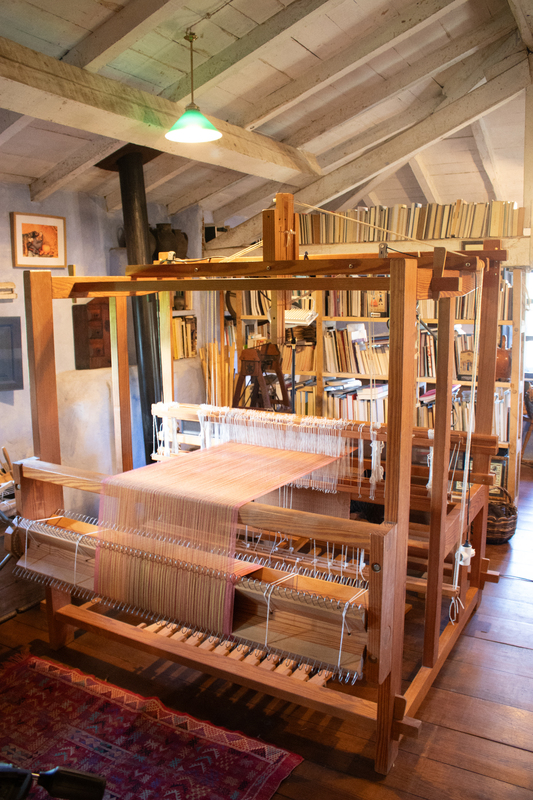
Paz uses a wide range of tools, as she carries out all the processes related to wool—from shearing to yarn production. For this, she has manual shears for shearing, tubs for washing, carding tools (including hand carders and drum carders), spinning tools (spindles, spinning wheels, and spinning machines), dyeing equipment (pots of various sizes, strainers, etc.), as well as several looms of different sizes and functionalities. Among them, one of the most notable is a 19th-century loom, which she uses to create traditional pieces, alongside more modern and larger looms. In total, she owns four looms. She also has warping tools, a skein winder, and naspas, which she uses to make cadexos or skeins. Additionally, she has three small looms dedicated to workshops and beginner courses, since the larger ones are usually occupied with ongoing projects. The looms include various types of shuttles, known as nezclas in Asturian. For designing her pieces, Paz uses pencil and paper, although she has also incorporated digital tools: she uses specialized software to create designs that are later transferred to the loom. The fact that the product is handmade doesn’t mean that new technologies aren’t integrated into certain parts of the process. All of her tools are second-hand and have been acquired from various markets, except for her first loom, which was new. Some come from antique dealers—like the 19th-century loom—and others from online resale platforms. The spinning wheels and spindles were made by her husband, Xandru, who practices woodworking as a hobby. He also built her spinning machine. Together, they maintain the looms and other tools. There are more modern and sophisticated tools available, such as computerized Jacquard looms, which offer great creative possibilities, although their cost is very high. The loom is, without a doubt, the central tool of her craft. Nevertheless, some tools have fallen out of use, such as manual spindles. Paz still uses the spinning wheel to produce handmade yarn with specific thicknesses and twists, which directly influence the texture of the final piece.
What are the practitioner’s relations with the tools they use? What meaning do the tools they use have to them?
The tools Paz uses are simple, yet deeply connected to her culture. She employs the oldest and most traditional ones to create heritage pieces. Building on that foundation, she has incorporated new tools that allow her to produce contemporary works without losing sight of the core principles of her craft. Her workshop is a vital space, where she establishes an intimate connection with her working tools. It is there that tradition and innovation coexist, and where each tool—no matter how modest—forms part of a meaningful artisanal process.
What sources of energy does the practitioner use?
Many of the processes in Paz’s workshop rely on her own manual energy, especially when working with the looms. The workshop is located in her home, where she uses heat from a cast-iron stove and a wood-burning heater. The firewood comes from local suppliers or from her husband’s family land. The workshop is lit with electricity supplied by a renewable energy cooperative, Astuenerxía (https://astuenerxia.coop). Finally, for the dyeing process, she needs energy to heat the pots of water used to dye the skeins. For this, she uses butane gas.
What waste is generated during production? How is it managed?
During the dyeing process, the water in which the skeins are submerged is discarded, along with the leftover mordants and dye residues. Since the quantities are very small, Paz uses this water in her vegetable garden, and it does not pose any toxicity issues. If the volume were significantly larger, it could become problematic. Most of the dyeing water is reused throughout the process, and only at the end is it discarded. It is a biodegradable waste composed of plant-based dye residues and alum, and is also used in the garden. Any leftover wool scraps are composted and used in the vegetable garden as well.
Workshop
Does the practitioner have a separate workshop/work space/etc.? Describe where it is located and what it is it like.
Paz has her textile workshop in her own home, in Puerma (Asturias). She began working in a single room, but over time it became necessary to renovate the house to expand the workshop space and incorporate more looms. Today, the workshop is a spacious and bright area, with multiple light sources where the looms are distributed. It is decorated with antiques and pieces from traditional Asturian material culture. It also functions as a small office, with books, a desk, and other elements, where she stores materials and part of her production. She is considering the possibility of having a larger workshop, as the current space is becoming too small, and adding a new loom would mean removing another. Moreover, if she ever decided to hire someone to work with her, she would need more space. Although she considers this possibility depending on her workload, she also feels that, given her age, it may not be the right time to take on such an investment. She believes that if she can sustain herself with what she already has, she could forgo growth that would bring complications such as hiring staff, financial investments, and bureaucratic procedures.
Products and services
What kind of items does the practitioner produce?
Paz produces all kinds of textile items, both inspired by tradition and by contemporary design. The products she sells the most—and which are most in demand—are scarves and shawls. These are fast-moving items that customers easily identify with, as they can purchase and use them immediately. However, these pieces are made with non-Asturian wool, often blended with silk, and Paz feels less connected to them, as they represent a more contemporary use of craftsmanship. In recent years, her production has evolved. She has worked on pieces for traditional Asturian clothing and historical reenactments, which are in some demand from folklore groups. Although she hasn’t abandoned the creation of ethnographic pieces—which still have a market—she is now committed to applying these same fabrics to contemporary uses. She believes that limiting the use of xalda sheep wool exclusively to traditional items would make little sense in today’s context. Paz firmly believes in the possibility of creating contemporary pieces based on tradition. For example, decorative motifs or techniques once used in skirts can now be applied to coats. For her, contemporary craftsmanship must combine innovation and design, and she considers collaboration between artisans and designers essential. She also distinguishes between “handmade” and “handcrafted.” The former may involve mechanized production, where different workers manually carry out parts of the process. The latter, however, implies that the artisan controls the entire creative process of the object. Regarding mechanization, Paz acknowledges that there are already industrial looms capable of producing pieces better than she can, and she doesn’t see the need to compete with them. She believes that if craftsmanship becomes mechanized, it loses what sets it apart as a truly artisanal creation. In her creations, she enjoys working with color, experimenting with pigments, threads, designs, and combinations. With xalda sheep wool, she enjoys exploring new designs and forms. One of the most interesting commissions she has received recently was the design of a wedding shawl: white, made with merino wool, off-white silk, and another shiny organic silk. She also incorporated alpaca, silk cashmere, and merino threads, playing with different shades of white. She also produces items for the home and interior decoration. Thanks to her deep knowledge of the craft, she explores new avenues in textile art applied to furniture and decor, always with a focus on quality, design, and functionality. For her, objects must have a practical purpose beyond their artistic value. Currently, she is working on developing new lines of basic products—high-quality but more affordable—to make textile craftsmanship more accessible to a wider audience. She is also developing a line of products made exclusively with xalda sheep wool, to promote this local raw material. She would love to work on signature pieces, special fabrics, and explore textile art in depth. She also dreams of preparing an exhibition or creating a unique piece for craft competitions. The main obstacle, however, is the lack of time.
For what purposes does the practitioner produce them?
The main purpose of all her production is for sale. Most of it is sold directly to the public, while another portion is made through commissions. In addition, part of her production is aimed at showcasing the potential of the xalda sheep and its wool in the creation of textile items.
If items are produced for sale, where are they being sold?
There are several sales channels. On one hand, her own website, where she sells part of the handcrafted items she produces. On the other hand, the fairs she attends, such as craft fairs, traditional markets, and similar events. She also takes on custom orders, for which she studies each case individually, develops proposals, and creates exclusive pieces
What kind of services (if any) does the practitioner offer?
She has taught workshops on wool preparation, dyeing, and loom weaving. In addition to developing her own textile production, she offers courses and training in loom techniques and working with wool. These courses are usually aimed at a different audience than those who purchase crafts, as they seek to bring traditional processes and knowledge closer to people interested in learning and experimenting for themselves.
Does the practitioner provide repair/utilisation services?
Paz is in charge of repairing any damage that the pieces she sells may suffer. Although customers usually take good care of them, it has occasionally been necessary to intervene to fix pieces that were dented or frayed, by repositioning the thread. On one occasion, she had to repair a piece that had been attacked by rodents and had several holes.
Who are the practitioner’s customers (both products and services)?
Many of her clients seek artisanal products connected to the region they are visiting. Initially, Paz tried to carve out a niche in traditional Asturian clothing, entering several competitions with that idea. However, commissions have been scarce. The cost of producing cloth for historical costumes on an old loom is very high, especially for garments that are only worn a few times a year. Paz describes her audience as predominantly female: women between 45 and 65 years old, with medium-high income levels and higher education, working in liberal professions. Ultimately, this is also a culturally engaged audience, as craftsmanship is a form of cultural expression. This profile tends to be environmentally conscious, precisely because of their educational background. There are also some men who purchase pieces as gifts. Foreign tourists especially value high-quality artisanal products. They don’t buy just anything—they look for specific pieces. If the product is good, it sells, and this type of customer rarely questions the price. There is great interest in wool, weaving, and loom workshops. Emotional connections with handcrafted items are much deeper than with industrial ones. These are not disposable objects or purchases driven solely by price: each piece has a story, and if you made it yourself, you keep it forever. However, not everyone has that sensitivity toward objects. The audience for the workshops usually doesn’t overlap with those who buy the pieces. The workshops are aimed at people seeking an experience. After the pandemic, there was a significant shift toward craftsmanship, with people interested in engaging in creative processes. Workshop participants are often people who already weave and want to learn about the loom or work with wool. It’s a younger audience, with a greater male presence. There is a potential market for sustainable, high-quality artisanal products, but there are no storefronts in central areas or advertising campaigns to make them visible. One of her main showcases is social media. She displays her products on Instagram and other platforms. Within Asturias, she is fairly well known in certain circles, which allowed her to establish a local niche before beginning a modest expansion. Her message, tied to Asturian identity, resonates with people aligned with Asturian cultural movements. However, she would like to access international sales channels. In Asturias, there are no specialized stores, and fairs offer very limited sales, so she is considering entering markets in major cities. The Basque Country is a nearby option she is considering.
Do the practitioner’s products/services have any certification/labels (e.g., place of origin, bio, organic, handmade, heritage product, etc.)? If yes, what?
Her production does not carry any official label or certification. Part of the wool she uses, which she sources from a supplier, is certified as organic by GOTS (Global Organic Textile Standard). She holds an artisan license from Asturias. However, in textile production, there are no specific certifications beyond those for organic wool or origin. In her case, she does not use more organic wool simply because she cannot find suppliers. She believes that the textile sector is still far from achieving widespread certification of this kind. There is an official Asturian craft label, but she feels it is not a sufficient quality filter. A label that guarantees product quality through clear standards and criteria would be necessary—one that reviews production processes and ensures traceability.
Tourism
Is the practitioner engaged in activities related to tourism? What kind of activities? When do they take place? Who are the tourists (e.g., domestic, foreign)?
She believes that visits to places should include a historical and ethnographic context that allows for a deeper understanding of the local culture, rather than focusing solely on the landscape. She is concerned that mass tourism and touristification can ultimately destroy these spaces. In her view, tourism companies are voracious, and she understands that it is a business that does not necessarily prioritize environmental or cultural preservation. She sees craftsmanship as having the potential to play an important role in promoting high-quality, responsible tourism. In recent years, she has been organizing open studio days at her workshop, which include a historical and ethnographic explanation of xalda wool textiles in Asturias. Visitors meet the flock of sheep and learn about their characteristics, followed by a demonstration of the textile process, accompanied by a small gastronomic offering. In collaboration with a local cured meats factory (Ca Mamina, https://camamina.com), she offers demonstrations and experiences related to wool and weaving, combining them with local cuisine and a short workshop on traditional music and dance. She is currently in the process of developing new activities linked to experiential tourism. The company Singular Spain (https://singularspain.es) has included them in its tourist circuits through Asturias.
Enter a direct quote from the interview (1-2 sentences) in the original language that reflects the practitioner’s feelings about the engagement with tourism (the quote should be potentially emotionally charged).
“Tampoco estoy en un sitio turístico. Si estuviera en Taramundi, toda mi clientela sería turista” […] “Sin control, ye un problema, si lo saben controlar… pero los huevos tan metíos na cesta del turismo”
Partnership
Is the practitioner a member of any group/organisation? Are there any co-creation spaces/projects they are taking part in? Are they partnering with other practitioners? Are they collaborating with academia (researchers/research institutions, etc.)? Are they collaborating with public institutions (local government, museums, archives, schools, culture centres, etc.)?
She is a member of the Asturias Artisan Union (https://www.saasturias.com) and of the Association for Textile Creation (https://creaciontextil.org). She is currently in the process of creating a new association together with other artisans, which will be called Blima. Outside the field of craftsmanship, she belongs to around ten associations related to music, culture, and other areas. She also collaborates with the livestock and cured meats company Ca Mamina. She partnered with chef Pedro Martino at his restaurant in Caces (https://pedromartino.es) for a presentation of dishes that incorporated textile materials. She is considering collaborations with fashion designers, such as Constantino Menéndez (https://madebykos.com). After all, she produces textiles, and her goal is to integrate her products into other creative levels. She is not a dressmaker, which is why working with designers is of particular interest to her. In Paz’s words, part of the future of craftsmanship lies in collaboration with designers: design enhances the product, and designers are beginning to work with textile artisans. The greatest challenge she sees in this regard is the potential invisibility of textile artisans within these collaborations. She also works with various public institutions, such as the Las Regueras Town Council, and with museums including the Ethnographic Museum of Grandas de Salime, the Museum of the Asturian People (Muséu del Pueblu d’Asturies), and the Interpretation Centre of Asturian Pre-Romanesque Art, among others.
Challenges
What are the challenges the practitioner encounters (can be related to the practice and its different aspects, life in a rural area in general, etc.)
She is pessimistic about the future of her craft and sees it in a rather bleak light, although she has only been working in the field for three years. Her products do not fit into the traditional channels of craft fairs, as they are high-end artisanal pieces. In Asturias, there are no proper platforms for showcasing this kind of craftsmanship. Craft fairs are very heterogeneous and lack strict criteria regarding the quality of the products presented, which means her work does not receive the visibility it deserves. In Galicia, by contrast, there are many shops offering high-quality artisanal products, committed to craftsmanship and supported by the regional government. The Galician government has succeeded in making society identify with its local products. One of the challenges in Asturias would be to improve sales channels: if someone wants to give a high-end artisanal gift, they often end up buying from souvenir shops. Living in a rural area is not a problem for her; in fact, she considers it the ideal environment for craftsmanship. A major challenge would be improving her working conditions. While the bureaucratic burden is bothersome—mainly because it takes up time—what she would most like is to be able to rest more and have more time for her personal life. Craft work consumes a large part of her vital time. Moreover, many artisans rely on other jobs to make a living. Craftsmanship is not their main source of income, and they cannot afford to leave their other occupations. Regarding contemporary creation, she aims to produce items that have a practical use today. If an artisanal product has no relevance in the present, it won’t succeed, and craftsmanship won’t survive. She believes that craftsmanship must have a function and utility in the contemporary world; otherwise, it is destined to disappear. In her case, she wants both xalda sheep wool and her artisanal work to go beyond the realms of anthropology and ethnography, and for people to recognize their practical value. In this sense, one of the challenges she believes craftsmanship faces is social change. To survive, craftsmanship must remain attentive and adapt to evolving social trends. It cannot remain on the sidelines—it must respond to these changes by developing new products, or it will disappear. Craftsmanship has always evolved, adapting to the needs of consumers. Mechanization is another challenge. If everything becomes mechanized, she feels it loses its meaning, as it results in standardized products that are the same for everyone. In her philosophy, there is a difference between making things by hand (even if produced in series) and creating things by hand, without losing the connection to the product being made. The artisan must maintain control over the entire process of creating the piece, unlike the industrialized concept of manual labor.
Enter a direct quote from the interview (1-2 sentences) in the original language that reflects the practitioner’s feelings about the challenges they face (the quote should be potentially emotionally charged)
“Mejorar la calidad en el diseño. En artesanía, debe ir de la mano del diseño, para adaptarse a las necesidades de un público actual. Puedes basarte en técnicas tradicionales, y combinar tradición con innovación, una base histórica sobre la que construyes.”
References
Add references to sources related to the practitioner (academic literature, secondary sources, media publications, museum and archival data, etc.). Add as many rows as necessary. One reference per row.
Yo soy rural - Paz Mesa. 18 febrero 2025. Disponible en: https://www.youtube.com/watch?v=GEvDLQ_706g.
Bertojo, Miguel (2023). «Paz González Mesa». 17 abril 2023. Disponible en: https://oficioyarte.info/paz-gonzalez-mesa/.
Marín Estrada, Pablo Antón (2022). ««La xente regala hórreos del siglo XVIII en Asturies… ye como pa facéselo mirar» - Pegados a la Tierra». EL Comercio. 9 enero 2022. Disponible en: https://pegadosalatierra.elcomercio.es/paz-gonzalez-mesa-tejedora-hilandera-las-regueras/ [consulta: 24 septiembre 2025].
Paredes, Ana Paz (2020). «Vivir en el campo tiene telar». La Nueva España. 23 julio 2020. Disponible en: https://www.lne.es/asturias/2020/07/23/vivir-campo-telar-14434932.html [consulta: 24 septiembre 2025].
Entry Author:
iain
Date of entry:
2025-09-29T13:03:04+00:00