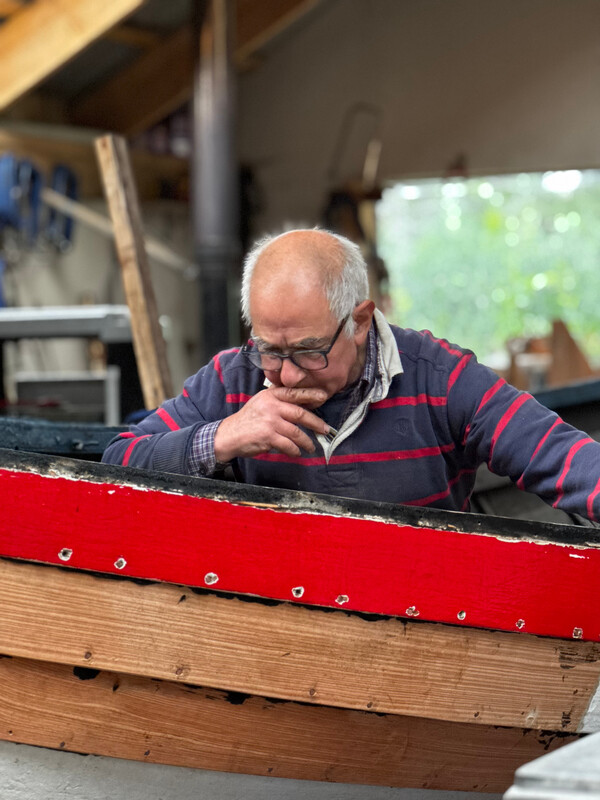
Mark Stockl
Location:
3 Loggie, ULLAPOOL, IV23 2SG
Country:
Scotland
Description:
Mark Stockl is a traditional boat builder who restores, repairs, designs and builds traditional timber boats. Based near Ullapool in the highlands of Scotland he has been working on a self-employed basis since 2006 after working at Ullapool Boat Buulders and prior to that completing an intensive, traditional boat building course in Lowestoft, Suffolk.

Relation to the area
incomer
After securing employment as a newly qualified traditional wooden boat builder.
| Title | Description | Type |
|---|
Occupation
woodwork,metalwork
Type of involvement
full-time paid job
Inventory ID:
AAS_PR_02
Author of the entry:
Netty Sopata
Start Date of Existence:
1950s
Gender:
male
Language:
English
Bio:
Mark Stockl is a traditional boat builder who restores, repairs, designs and builds traditional timber boats. Based near Ullapool in the highlands of Scotland he has been working on a self-employed basis since 2006 after working at Ullapool Boat Buulders and prior to that completing an intensive, traditional boat building course in Lowestoft, Suffolk.
Social Media:
E-Mail:
mark.stockl@hotmail.co.uk
Phone:
MOBILE 07903 816 508 LANDLINE 01854 655336
Knowledge and skills
What knowledge and skills are essential for the practitioner to engage with the cultural practice?
Extensive. An understanding of the traditional wooden boat building techniques and ability to apply them through thousands of hours of practice. The sequence in which the techniques need to applied and how to accommodate solo working to accomplish the highest quality. There is an aesthetic quality to wooden boats but fundamnetally thay are a functional item used to carry people in water. The traditonal wooden 'Sgoths'. that Mark can build from start to finish, or repair, are used for sailing in some of the most challenging sea areas in Scotland.
How did the practitioner acquire those knowledge and skills?
Mark "messed around in boats" throughout his childhood but his first career was as musican (classical guitarist). After becoming disillusioned with the music industry he chose to study traditional boat building at a boat building school Lowestoft in Suffolk. This was a year-long, intensive course where students spent at least 6 - 8 weeks leanring high-level joinery skills before being shown boat building techniques. after this course, Mark applied for and got a job advertised at The Ullapool Boat Builders in Scotland. In 20026 he established his own business after the Ullapool Boatbuilders closed.
Does the practitioner teach anyone the skills they possess? Who? How?
Boat Building course at Plockton High School form 2007 to 2023
Material
What materials does the practitioner use?
Larch (wood) for planking and fittings and Oak (wood) for ribs. Copper for fixtures and fittings but also stainless steel (occassionaly). All sourced from Scotland. The furthest he has travelled to collect Larch is Perthsire. Larch is getting harder to source due to it becoming a popular choice of architects in building designs.
Where does the practitioner get materials from?
WOOD:Scotland. He does not want to import any from abroad.
How does the practitioner manage leftovers?
Due to traditional techniques being used there are are very little leftovers, with the long thinner pieces of the planks being used in the final fittings of the boat. When the edges of the planks are trimmed, these are burnt and not used in the build becasue they are weaker.
Production
What techniques does the practitioner use?
The Making process of a New Boat requires the following techniques / stages of production (recorded from -35.00 on AAS_PR_002(INTVW)). SHAPE Determining the shape of the boat is the first stage. The client has an input at this point and Mark has a selection of moulds/temporary forms that he uses to create these shapes. Mark ‘builds by eye.’ Although he has in the past worked from technical drawings, he finds the process restrictive. Once a shape has been determined the backbone or the ‘keel’ is placed with three of the selected moulds at the stern, bow and in the middle. The structure is braced/racked to retain the shape. PLANKING Planking can then commence. The height and ‘sheer’ of the boat will have been calculated at this stage. The ‘sheer’ is the shape of the boat from the bow to the stern. If a boat rises slightly at the bow and the stern they can throw more water off, this makes them good sea boats. Planking (the process of layering the lengths of wood that form the sides of the boat) is completed in pairs. Retention of symmetry is important at this stage. There are also different planking techniques. For example, on AAS_AR_10 (the boat being restored in the AAS_PR_02(INTVW)) is a ‘clinker’ boat. This means the planks overlap each other. In other wooden boats, such as ‘Carvel’ ones, the planks are layered on top of each other. RIBS After planking, the moulds can be removed and the ribs placed and fixed. The ribs are made from oak and after being cut by machine they are put in a steam box for 30 – 45 minutes. Once removed from the steamer there is a window of 15 seconds for them to be placed and fixed. Because of this, their positions are pre-marked on the hull of the boat and placement nails are positioned in pre-drilled holes, ready for one person to hold the rib in place and another working on the underside of the boat to hammer the copper nails through the planks and into the rib. The steamed oak accepts these nails and shaping. A process of ‘Roving’ – application of copper rivets on the ends of the nails, completes the fixing of the ribs. After this process the boat retains its own rigidity. FITTING OUT This process involves the fitting of the seats, gunnels, rub strips etc and is the longest stage of the process. It takes six months to build a wooden boat using traditional techniques (as described).
What tools does the practitioner use?
Hand chisels and planes – traditional hand tools fro wood workers. Battery operated hnad tools such as drills / routers. Circular saws. Steam box for steaming oak. Clamps (for holding pieces of wood in lace).
What are the practitioner’s relations with the tools they use? What meaning do the tools they use have to them?
Every tool has a different function and is applied to differtn techniques at different stages of the build / restoration.
What sources of energy does the practitioner use?
Mains electricity for power tools and a wood burning stove for heat. The studio has LED lighting.
What waste is generated during production? How is it managed?
Very little waste is generated due to traditional build techniques being used. The thinner pieces of the planks are used in the finishing of the boat. Any left over sections which are mostly the edge of the planks (which is weaker and less stable for boat building) is used as fuel in Mark's stove - this provides heat for the workshop.
Workshop
Does the practitioner have a separate workshop/work space/etc.? Describe where it is located and what it is it like.
The workshop is in a barn situated on Mark's Croftland in Loggie. It is situated just off the driveway which leads down to the house and holiday home. There is a spacious external yard area around the shed where boats and wood supplies can be stored. In June 2025 an addtional shed area was under construction to provide more workshop space.
Products and services
What kind of items does the practitioner produce?
Traditional wooden boats for example: 'Clinkers' and 'Sgoths.' The business model is a bespoke 1:1 client focused model. Individual items are not produced and sold unless someone has commissioned them.
For what purposes does the practitioner produce them?
For sailing, rowing and fishing
Tourism
Partnership
Challenges
References
Date of entry:
2024-10-20T12:06:21+00:00