Skip to content

Stan, Anuța

Location:

Săpânța, Maramures, Romania

Country:

Romania

Description:

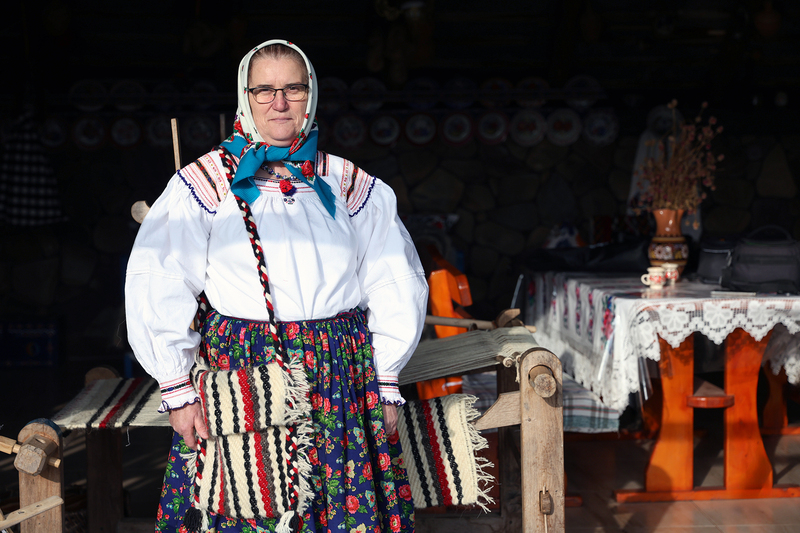
She is a native of Săpânță, her grandmother introduced her into the practice of weaving at the age of 5, later on when she was 15 she was hired as to work at home within a workers cooperative. She has been weaving within this arrangement for 15 years, and after retiring she continued to supported her family of 3 children alongside her husband. They made a living out this job, creating traditional bags: traistă (in Romanian), carpets (cergi in Romanian), etc.

Relation to the area

native

Title Description Type

Occupation

fibre and textile crafts,artist

Type of involvement

full-time paid job

Inventory ID:

CJMM_PR_02

Author of the entry:

Noemi Ganea

Start Date of Existence:

1961

Gender:

female

Language:

Romanian

Bio:

She is a native of Săpânță, her grandmother introduced her into the practice of weaving at the age of 5, later on when she was 15 she was hired as to work at home within a workers cooperative. She has been weaving within this arrangement for 15 years, and after retiring she continued to supported her family of 3 children alongside her husband. They made a living out this job, creating traditional bags: traistă (in Romanian), carpets (cergi in Romanian), etc.


Knowledge and skills

What knowledge and skills are essential for the practitioner to engage with the cultural practice?

Dexterity, manual skills and practice

How did the practitioner acquire those knowledge and skills?

Her mother and especially her grandmother taught her the entire process from shearing, scouring, shedding to carding .

Does the practitioner teach anyone the skills they possess? Who? How?

It is a family practice that she passed on to her daugther Mariana, but she is engaged in public events, promoting her skill to the wide public, making sure that the manual production of wool will not be forgotten

Material

What materials does the practitioner use?

She uses first hand wool from the local sheep breeders and occasionaly from outside the region. She uses vegetal colors from plants like walnut leaves, red onions, privet for black color. The long fibers of wool are left white while the shorter yellowish wool will be colored.

Where does the practitioner get materials from?

Locally from breeders most of the time.

How does the practitioner manage leftovers?

No leftovers

Production

What techniques does the practitioner use?

She manages the entire process manually

What tools does the practitioner use?

She has the loom (război de țesut) more that 100 years old, reel (crâng/vîrtelniță), carder (rășchitor), sley (sucală), warp (urzoi), spindle (fuse), spinning wheel for a thicker type of wool (drugă/fuior)

What are the practitioner’s relations with the tools they use? What meaning do the tools they use have to them?

All her tools that she currently uses have been inherited from her grandmother so they have a personal significance, more than 100 years old.

What waste is generated during production? How is it managed?

She says that there is no waste in the process

Workshop

Does the practitioner have a separate workshop/work space/etc.? Describe where it is located and what it is it like.

Yes, next to her home she has an annex equipped.

Products and services

What kind of items does the practitioner produce?

She produces traditional bags ( traistă), blankets (cergi) and carpets

For what purposes does the practitioner produce them?

She sells these items making a living out of it

If items are produced for sale, where are they being sold?

She participates to dedicated events like local, regional or national craftsmen fairs, tourism related fairs and she is also available to provide commissioned item

Does the practitioner provide repair/utilisation services?

No

Who are the practitioner’s customers (both products and services)?

Tourists mainly both national and international that look for souvenirs.

Do the practitioner’s products/services have any certification/labels (e.g., place of origin, bio, organic, handmade, heritage product, etc.)? If yes, what?

No

Tourism

Is the practitioner engaged in activities related to tourism? What kind of activities? When do they take place? Who are the tourists (e.g., domestic, foreign)?

Yes, she is often invited to dedicated tourism fairs where is given a live demonstration of her craft

Enter a direct quote from the interview (1-2 sentences) in the original language that reflects the practitioner’s feelings about the engagement with tourism (the quote should be potentially emotionally charged).

My hands are my visit card for all those enthusiasts of Maramures

Partnership

Is the practitioner a member of any group/organisation? Are there any co-creation spaces/projects they are taking part in? Are they partnering with other practitioners? Are they collaborating with academia (researchers/research institutions, etc.)? Are they collaborating with public institutions (local government, museums, archives, schools, culture centres, etc.)?

She is steady collaborator of the County Council of Maramures especially within national and international events dedicated to the promotion of tourism and of the regional brand

Challenges

What are the challenges the practitioner encounters (can be related to the practice and its different aspects, life in a rural area in general, etc.)

Access to a wider market, lacking of marketing skills

Enter a direct quote from the interview (1-2 sentences) in the original language that reflects the practitioner’s feelings about the challenges they face (the quote should be potentially emotionally charged)

I created my entire life, i built up my house and raised my children with the use of my skill, so i am lucky to be able to provide for myself by use my talent and skill that my grand mother passed on to me.

References


Entry Author:

iao@st-andrews.ac.uk

Date of entry:

2025-06-12T14:22:21+00:00