Skip to content

Lie, Ragnhild

Country:

Norway

Description:

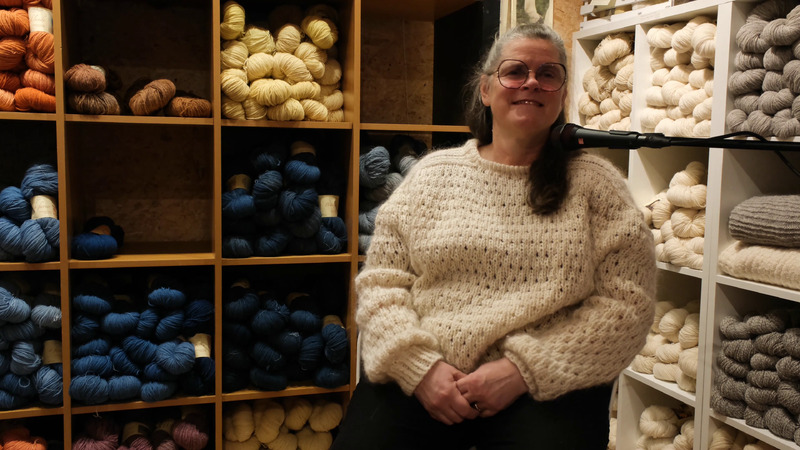
Ragnhild Lie grew up in Gudbrandsdalen and Lillehammer and has knitted, chrochet, braided, sewn and woven since she was little. Ragnhild is educated as textile artisan and holds a MA in Textiles from Bergen school of Art took in 1997. Her broad range of textile-based experience includes fine art, theater and education. She has worked at Sjølingstad Wool Mill, studied tapestry at Oslo University College of Art and Design, taught at Lofoten School of Arts for kids and led courses from kindergarten to university level. She works as lecturer and textile artist within the textile field in Norway. She now lives and works on the farm in Stamsund where she manages and develop the business Lofoten Wool established in 2014. On the farm of Lofoten Wool business, Ragnhild has a herd of 30 sheep which provide the company with wool and meat. The meat is sold to a local slaughterhouse (located in Leknes, about 7 km from Lofoten Wool), while the wool is processed in order to create the woolen products sold in the Lofoten Wool shops, online and to third party resellers. Environmental sustainability is the key principle of Ragnhild's corporate and production philosophy.


Relation to the area

incomer

The practitioner moved to Lofoten before 2013 but not specified when, almost casually. According to Ragnhild, Lofoten is an Eldorado for wool and lamb/sheep meat that wasn't developed. Most of the wool produced in Lofoten was and still is exported to England to never come back to Norway. Ragnhild realised she should have taken action to reverse this trend and to give new prominence to the wool produced by Lofoten sheep at a more local level.

Title Description Type

Occupation

fibre and textile crafts,artist

Type of involvement

full-time paid job

Inventory ID:

MN_PR_01

Author of the entry:

Elisabeth Rosa Brusin, Ole Andreas Sagmo, Rebeca Franco Valle

Start Date of Existence:

1966

Gender:

female

Language:

Norwegian

Bio:

Ragnhild Lie grew up in Gudbrandsdalen and Lillehammer and has knitted, chrochet, braided, sewn and woven since she was little. Ragnhild is educated as textile artisan and holds a MA in Textiles from Bergen school of Art took in 1997. Her broad range of textile-based experience includes fine art, theater and education. She has worked at Sjølingstad Wool Mill, studied tapestry at Oslo University College of Art and Design, taught at Lofoten School of Arts for kids and led courses from kindergarten to university level. She works as lecturer and textile artist within the textile field in Norway. She now lives and works on the farm in Stamsund where she manages and develop the business Lofoten Wool established in 2014. On the farm of Lofoten Wool business, Ragnhild has a herd of 30 sheep which provide the company with wool and meat. The meat is sold to a local slaughterhouse (located in Leknes, about 7 km from Lofoten Wool), while the wool is processed in order to create the woolen products sold in the Lofoten Wool shops, online and to third party resellers. Environmental sustainability is the key principle of Ragnhild's corporate and production philosophy.

Social Media:

facebook instagram

E-Mail:

post@lofoten-wool.no

Phone:

0047 90 50 40 01


Knowledge and skills

What knowledge and skills are essential for the practitioner to engage with the cultural practice?

Sheep care and farming, plant dying with natural materials, wool processing, textile construction on the loom, knitting, design of knitting patterns, needle binding.

How did the practitioner acquire those knowledge and skills?

She learnt to craft with threads since she was a child from her mother and grandmother, specifically knitting and hand made rugs. She learnt crochet tapestry in middle school, and later many different weaving techniques, e.g. card weaving (brikkevev), grindvev, warp-weighted loom and . In 1997 she acquired a MA in Textiles. In the present, she keeps on increasing her knowledge through her own research in books and talking to museum conservators.

Does the practitioner teach anyone the skills they possess? Who? How?

Teaching employees, school teachings, doing art proyects, and courses for adults.

Material

What materials does the practitioner use?

Wool and silk

Where does the practitioner get materials from?

Much of the wool production comes from local farmers that respect animal wellfare. Besides this, her own sheep are also The silk and some of the dyes are not local, and have to be inmported.

How does the practitioner manage leftovers?

There are not many leftovers of the production

Production

What techniques does the practitioner use?

Knitting and weaving. Dying with natural dyes.

What tools does the practitioner use?

She uses a modern knitting machine and a weaving machine.She also employs 50 persons knitting for her,. Mostly woman, adult and retired ladies as a contribution to their pension.

What are the practitioner’s relations with the tools they use? What meaning do the tools they use have to them?

It is a pragmatic relationship. When a machine stops working, it has to be fixed.

What sources of energy does the practitioner use?

The general electric supply

What waste is generated during production? How is it managed?

There is very little waste generated. The wool leftovers are compostable.

Workshop

Does the practitioner have a separate workshop/work space/etc.? Describe where it is located and what it is it like.

The practitioner has separated rooms in her own house to practice, manage and store some parts of the production. She also has buildings to keep the animals (sheep) during the winter, as well as a plot of land for the summer pastures.

Products and services

What kind of items does the practitioner produce?

Yarn, jumpers, mittens, socks, scarfs, curtains, pillow cases and blankets.

For what purposes does the practitioner produce them?

For daily use as clothing or interior dressing, and meat for consumption.

If items are produced for sale, where are they being sold?

They are sold in businesses of the area interested in selling handcrafts to tourists, such as Lofotr Viking Museum. The yarn is sold in yarn stores throughout the country. Besides this, some exclusive businesses order textiles for interiors (Hotels and tourist business). There is also a shop in the farm and they have an online shop in their website.

What kind of services (if any) does the practitioner offer?

Eventual workshops for learning how to use the yarn. Workshops for learning how to dye with plant dyes and visits to the farm.

Does the practitioner provide repair/utilisation services?

Yes, but they have been rarely used.

Who are the practitioner’s customers (both products and services)?

Tourist that want to have high-quality local products, particular that knit themselves. Local businesses such as shops and hotels. The online shop sells directly to customers worldwide.

Do the practitioner’s products/services have any certification/labels (e.g., place of origin, bio, organic, handmade, heritage product, etc.)? If yes, what?

They have their own hand-made tags with information about the sheep breed and the kind of natural dye used to color the yarn, but no official certifications.

Tourism

Is the practitioner engaged in activities related to tourism? What kind of activities? When do they take place? Who are the tourists (e.g., domestic, foreign)?

They have some tourist-oriented selling points (Ie. Lofotr Viking Museum). Many people going to the museum and buying products there also go to visit the farm afterwards. They also buy directly in the farm shop. A popular product loved by the America tourists are the Norwegian sweaters. Workshops and visits to the farm are also offered under request. Tourists come from the whole world to Lofoten, where the workshop is located. The greater bulk of tourists is European, with a majority of Germans. Local national tourists are also generously represented.

Enter a direct quote from the interview (1-2 sentences) in the original language that reflects the practitioner’s feelings about the engagement with tourism (the quote should be potentially emotionally charged).

Ullturisme er da jo veldig stor i veldig mange andre land. Du kan dra til Scotland, Island, Farøyene og Ytre Hebridene og overalt så er det mye fokus på ull og sau, og hvor viktig sauen har vært for mennesker her i nord. Men det gjør vi veldig lite her i Norge. Når jeg får tid, vil jeg får gjort det.

Partnership

Is the practitioner a member of any group/organisation? Are there any co-creation spaces/projects they are taking part in? Are they partnering with other practitioners? Are they collaborating with academia (researchers/research institutions, etc.)? Are they collaborating with public institutions (local government, museums, archives, schools, culture centres, etc.)?

The collaborate with the local farmers that bring wool for them, wool shearers, the husflidlaget, knitting festivals,the slaugtherhouse, and other artisans of the area. They are members of creative associations such as the Norske Kunsthandverkerer and Norske Billedkunstnerer as well as farmer associations such as Småbrukerlaget, Bondelaget and education groups such as Utdanningsforbundet. With Norske Kunsthandverkerer they actively collaborate in artistic exchanges and exhibition projects. They also collaborate with academia in a project in Tingvall with the Norwegian Institute of Bioeconomic Research called "Amazing Grazing". It researchs sheep farming as a sustainable industry for Norway, analysing the impacts in the landscape, climate and economy of the processes involved in farming, and the long-lasting life of derivates such as wool textile.

Challenges

What are the challenges the practitioner encounters (can be related to the practice and its different aspects, life in a rural area in general, etc.)

One of the challenges is to get the wool and prepare it for selling. There are no local wool preparation plants, so she has to send the locally sourced raw material and send it to a cleaning plant. After that, the wool is send to the workshop and crafted into yarn and the other products. The combination of the farm managing and modern life is also challenging, specially in the areas where people have their holyday houses (hytte), and carry on with modern lifestyles, while the sheep need the space to graze unfenced. There are also economic challenges since the sheep farming does not generate a lot of money.

Enter a direct quote from the interview (1-2 sentences) in the original language that reflects the practitioner’s feelings about the challenges they face (the quote should be potentially emotionally charged)

Det er jo veldig få som klarer å lage penge på å jobbe med sau i Norge nå. Så det er en stor spørsmål: hva gjør vi mellon brukerer videre? hvordan... hvor får vi maten fra? hvor får vi klærne våres fra? Hva er viktigst? Skal vi bygge ut og bygge ned oss natur eller skal vi letter etter forbinde her og levelige kår?

References

Add references to sources related to the practitioner (academic literature, secondary sources, media publications, museum and archival data, etc.). Add as many rows as necessary. One reference per row.

https://lofoten-wool.no/en
https://www.nibio.no/prosjekter/amazing-grazing-baerekraftig-kjott-og-ull-fra-sau-som-beiter-i-norsk-utmark?locationfilter=true
https://www.smabrukarlaget.no/aktuelt/bonde-og-smaabruker/,
https://www.norskekunsthandverkere.no/kunstnerregister/ragnhild-lie
https://husflid.no/
https://www.utdanningsforbundet.no/
https://www.bondelaget.no/
Esther Haukeland, Innføring til plantefarging. Cappellen, 1982.
Animalia: Norwegian wool Standard. https://www.animalia.no/no/Dyr/ull-og-ullklassifisering/norsk-ullstandard/
Beder, Nicolina J., Seyður Ull Tøting. SPF. Sprotin, 2010.
Flååt, Inger. Votter i Namdalen. Nauma Husflidslag, 2010.
Grimstad, Ingun K. and Sårdal, Tone t. Norsk Strikkehistorie. Vormedal Forlag. 2018.
Grimstad, Ingun K. and Sårdal, Tone T. Ren ull. Aschehoug, 2013.
Hrútaskrá. https://www.rml.is/is/kynbotastarf/saudfjarraekt/hrutaskra
Joensen, Robert. Seyðabókin. SPF. Sprotin, 2015.
Johnston, Elizabeth and Juuhl, Marta K. The warp-weighted loom. Kljásteinavefstadurinn: kljásteinar klingja. Oppstadveven: klingande steinar. Skald, 2016.
Kjellmo, Ellen. Båtrya i gammel og nyt tid. Orkana, 1996.
Sundbø, Annemor. Usynlege Trådar i Strikkekunsten. Samlaget, 2006.
https://www.norskebilledkunstnere.no/


Entry Author:

iain

Date of entry:

2025-06-18T09:52:25+00:00