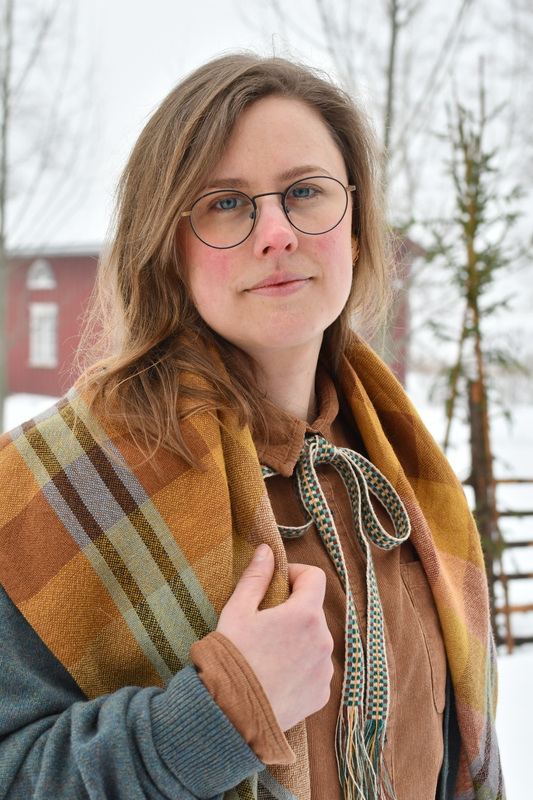
Henner, Therese
Country:
Sweden
Description:
Therese works part-time with her own company Sirli Textil och part-time at Klässbols linneväveri (linen weaving). In her company she primarily works with different weaving techniques. She's also plant dyes and eco-print. She makes primarily everyday textile artefacts. She holds lectures, courses and exhibitions within her field. Her studio is at Gammelvala (open air folk museum) in Brunskog. Therese works with traditional weaving techniques such as tapestry and pick-up techniques such as rölakan, rya, HV-technique/woven transparency and pulled warp. Shuttled weaving techniques and traditional patterns that are of frequent use in her woven expression in rosepath, monk’s belt, dukagång and overshot weave. She has a genuine interest of sustainable practices, cultural heritage and questions regarding nature.

Relation to the area
native
| Title | Description | Type |
|---|
Occupation
fibre and textile crafts
Type of involvement
part-time paid job
Inventory ID:
RV_PR_03
Author of the entry:
Ulrika Jäger, Sara Olsson
Start Date of Existence:
1986
Gender:
female
Language:
Swedish
Bio:
Therese works part-time with her own company Sirli Textil och part-time at Klässbols linneväveri (linen weaving). In her company she primarily works with different weaving techniques. She's also plant dyes and eco-print. She makes primarily everyday textile artefacts. She holds lectures, courses and exhibitions within her field. Her studio is at Gammelvala (open air folk museum) in Brunskog. Therese works with traditional weaving techniques such as tapestry and pick-up techniques such as rölakan, rya, HV-technique/woven transparency and pulled warp. Shuttled weaving techniques and traditional patterns that are of frequent use in her woven expression in rosepath, monk’s belt, dukagång and overshot weave. She has a genuine interest of sustainable practices, cultural heritage and questions regarding nature.

Knowledge and skills
What knowledge and skills are essential for the practitioner to engage with the cultural practice?
Henner’s paternal grandmother taught her to crochet when Henner was a child, and her mother taught her to sew when Henner was around 10-11 years old. She’s studied two year of textile and two years of textile and arts education at University of South-Eastern Norway and holds a bachelors of Arts and crafts (textile). Then she received a scholarship for further studies of weaving 2019-2020 at Ritwa Lingrot (traditional weaving) and Gunilla Brander-Smedberg (tapestry and plant dying).
How did the practitioner acquire those knowledge and skills?
See above
Does the practitioner teach anyone the skills they possess? Who? How?
Lectures, courses, workshops focus on heddle loom, and mending fabric. Course in eco-printing on vocational schools (folk high school). Have also been guest lecturer at University of South-Eastern Norway (campus Notodden’s textile education). She’s taught at the study association in Karlstad and held workshops at Rackstadmuseet and the municipality of Arvika. She sees there’s a growing interest for weaving in all ages, primarily in women.
Material
What materials does the practitioner use?
Henner chooses primarily natural materials such as linen and wool, both with rich traditional use in Sweden. She also to some extent uses cotton and hemp. Natural fibers are important for her and sees no alternatives.
Where does the practitioner get materials from?
Henner buys her wool yarn from Swedish manufacturer: Garnhuset Kinna textil as well as wool "pälsullgarn" from Rauma (Norway). Henner buys her linen yarn from Holma (the fibers are grown in Eastern Europe and France). For eco-print fabric she imports thin wool shawls from England.
How does the practitioner manage leftovers?
Henner has gotten linen yarn from the 1930-40’s and other yarns from estates in the local area where she lives. She also buys second hand. Since short yarns can be used for decorations in weaves, she collects and uses what she cans or arranges so that others can use leftover yarn.
Production
What techniques does the practitioner use?
Weaving, crocheting, sewing
What tools does the practitioner use?
All tools necessary for hand weaving on a counterbalance (floor) loom, band loom or a heddle loom. Weft, warp, scissors, equipment for dying, different needles...
What are the practitioner’s relations with the tools they use? What meaning do the tools they use have to them?
Henner has her mother's tailor's scissor, which was a present and she still uses. The floor loom "Öxabäck" she uses, which Henner describes as the "rolls royce" of looms, is so tall that she can either stand or sit while weaving which fits her height of 1.7m. Henner also has a loom after her maternal grandmother in the farm house of her family home, but the wood has warped and is no longer useable. There was also a small ridgid heddle loom found in the insulation of her family home's attic, which was mended with linen thread and is used by Henner now.
What sources of energy does the practitioner use?
The studio is heated with electricity. Her home is heated with a wood burning stove and electricity.
What waste is generated during production? How is it managed?
There's no waste.
Workshop
Does the practitioner have a separate workshop/work space/etc.? Describe where it is located and what it is it like.
Currently involved in a course at vocational school in Stöllet, Värmland. Next time she’s teaching there is summer of 2025.
Products and services
What kind of items does the practitioner produce?
Primarily hand woven cushions, lamp shades, jewelry, band and shawls.
For what purposes does the practitioner produce them?
She makes applied arts which are for use, beauty and joy in the homes of people.
If items are produced for sale, where are they being sold?
They are sold at Konsthantverkarna i Arvika, Rackstadmuseet (Arvika) and at her studio outside of Arvika.
What kind of services (if any) does the practitioner offer?
She provides repairation services.
Does the practitioner provide repair/utilisation services?
Yes. Henner believes that it's important that an older object can have an extended life if it's mendable.
Who are the practitioner’s customers (both products and services)?
Mainly women between 50 - 70 years old.
Do the practitioner’s products/services have any certification/labels (e.g., place of origin, bio, organic, handmade, heritage product, etc.)? If yes, what?
Her studio is situated at (above all at summertime) well-visited open-air museum in Värmland. The association which runs the place also arranges events such as markets throughout the year, which are popular. Each summer the the week-long event “Gammelvala” is arranged (in dialect translated to old world), during which all the area is filled with activities connected to cultural heritage. Tourists visiting can see Henner’s studio during this week too, but Henner has no activities of her own connected to tourists.
Tourism
Is the practitioner engaged in activities related to tourism? What kind of activities? When do they take place? Who are the tourists (e.g., domestic, foreign)?
Jag ställer inte ut på marknader förutom här på hembygdsgårn eller som dom marknader som vi har här och evenemangen som Gammelvala och så och då har jag ju öppen atelje med försäljning härifrån så och inget stånd nere på området och det är ju både positivt och negativt. För naturligtvis hade ju fler folk sett mig om jag hade haft en plats som var mer öppen och tillgänglig, samtidigt så är det kan det vara svårt fortfarande med konsthantverk på det sättet jämte utbudet på såna marknader och det är prismässigt naturligtvis för det blir en ganska stor skillnad. En tanke med det att jag inte vill stå därnere är ju att jag vill visa och sälja mitt hantverk liksom nära där jag också producerar eller skapar det för det ger ett mervärde till kunden och en förhoppningsvis en förståelse för tiden som är lagt på produkten. När man ser ateljen och verktygen och så.
Enter a direct quote from the interview (1-2 sentences) in the original language that reflects the practitioner’s feelings about the engagement with tourism (the quote should be potentially emotionally charged).
Member of Arvika konsthantverk (Arvika’s Arts and Crafts) which is an economic association with a store in central Arvika with an exhibition space. It’s a well-established association which has been around for about 120 years. She’s also a member of The Artists' Association of Sweden. As of 2025, she's a member of the project Co-craft Collection Experiment about natural dyes. (more: https://www.instagram.com/cocraftcollection/)
Partnership
Is the practitioner a member of any group/organisation? Are there any co-creation spaces/projects they are taking part in? Are they partnering with other practitioners? Are they collaborating with academia (researchers/research institutions, etc.)? Are they collaborating with public institutions (local government, museums, archives, schools, culture centres, etc.)?
Member of Arvika konsthantverk (Arvika’s Arts and Crafts) which is an economic association with a store in central Arvika with an exhibition space. It’s a well-established association which has been around for about 120 years. She’s also a member of The Artists' Association of Sweden. As of 2025, she's a member of the project Co-craft Collection Experiment about natural dyes. (more: https://www.instagram.com/cocraftcollection/)
Challenges
What are the challenges the practitioner encounters (can be related to the practice and its different aspects, life in a rural area in general, etc.)
Time is an important factor, and to take time for development. There’s a pressure of production. Social media takes a lot of effort to be active enough. It’s important to stand out “in the crowd”, digitally even though it’s easier these days living rurally.
Enter a direct quote from the interview (1-2 sentences) in the original language that reflects the practitioner’s feelings about the challenges they face (the quote should be potentially emotionally charged)
"Det tar nån timme att fundera ut vad man ska skriva i dom där inläggen. Det är inte bara att lägga upp vad som helst."
It takes about an hour to figure out what to write in these posts. It’s not just about posting anything.
References
Add references to sources related to the practitioner (academic literature, secondary sources, media publications, museum and archival data, etc.). Add as many rows as necessary. One reference per row.
Konsten att väva. En praktisk handbok. Av Åsa Pärson och Amica Sundström. ISBN: 9978-91-7887-085-1
Handbok i vävning. Bindningslära med konstvävnader. Av Ulla Cyrus- Zetterström. ISBN: 91-36-00445-6
A handweavers patterns book, by Marguerite Proter Davison ISBN: 9781626548428
Tapestry with pulled warp. Inspiration, Technique and the Creative Process. Av Susan Iversen. ISBN: 987-0-7643-5933
Entry Author:
iain
Date of entry:
2025-06-18T14:31:22+00:00