Skip to content

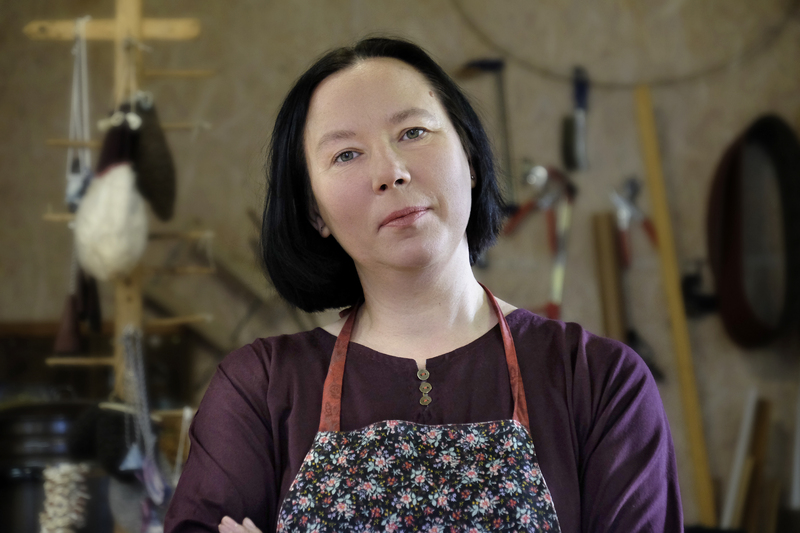
Monika Hint

Location:

Koordi farm, Kibeküla, Viljandi municipality, Viljandi county, Estonia

Country:

Estonia

Description:

Monika Hint, an alumna of the University of Tartu Viljandi Culture Academy, runs her own studio, Koordikamber, in Koordi farm in Viljandi county, Estonia. Collaborating with fellow artisans, local farmers, and hunters, she uses bone, horn, leather, wool, and other natural, often recycled materials to create products that build on and develop further traditional technologies. Koordikamber also offers courses and workshops.


Title Description Type

Occupation

leatherwork

Type of involvement

full-time paid job

Inventory ID:

UTARTU_PR_01

Author of the entry:

Kristi Grünberg

Start Date of Existence:

1969

Language:

English,Estonian

Bio:

Monika Hint, an alumna of the University of Tartu Viljandi Culture Academy, runs her own studio, Koordikamber, in Koordi farm in Viljandi county, Estonia. Collaborating with fellow artisans, local farmers, and hunters, she uses bone, horn, leather, wool, and other natural, often recycled materials to create products that build on and develop further traditional technologies. Koordikamber also offers courses and workshops.

Social Media:

facebook instagram

E-Mail:

hello@koordikamber.ee

Phone:

3725171207


Knowledge and skills

What knowledge and skills are essential for the practitioner to engage with the cultural practice?

Monika Hint's fascination with bone material lies in its plasticity, natural tone and beauty of form. Learning about old techniques helps her to recognise the material and to use it in a sustainable and meaningful way. To preserve the naturalness of the objects, she uses the fire-water-sun method of making the pieces, i.e. heating, cleaning in a water drum, sanding and sun bleaching. She draws inspiration for her work from archaeological finds and neighbouring peoples. Still, she is most inspired by the form of the material itself, which can also be described as natural design. Combining bone material with other natural materials, such as plants, oils, waxes, and resins, allows her to create beautiful and long-lasting compositions.

How did the practitioner acquire those knowledge and skills?

Monika has been crafting since an early age as her mother was a craftswoman, and so were her grandparents and great-grandparents. She has learned a lot about working independently with natural materials by curiously experimenting. Enthusiasm, insight, theory and practical experience came from studies at the UT Viljandi Academy of Culture in folk textiles and the Master's programme in heritage technology. She is now trying to complement all this with a degree in philosophy at Tallinn University. If she would like to learn more, it would be something to do with natural materials, perhaps their chemical structures and properties.

Does the practitioner teach anyone the skills they possess? Who? How?

Monika organises and offers courses and workshops in her studio Koordikamber, and elsewhere in Estonia. She has taught at the University of Tartu Arts Centre and runs internships at the UT Viljandi Cultural Academy. She also tries to pass on her skills to her three daughters.

Material

What materials does the practitioner use?

Collaborating with fellow artisans, local farmers, and hunters, Monika uses bone, horn, leather, wood, stone, clay, wool and other natural, often recycled materials. Sourcing materials is not complex for her. She finds a lot of stuff lying around that could be used to make more durable and valuable objects. She likes to work on a material basis, i.e. if she gets a bag of leather from somewhere, she thinks of what could be made from it rather than the other way around. The material itself gives her ideas. So, no excess energy is spent chasing and stockpiling something. When one material runs out and cannot be replenished, she uses the next one, from which new products are born.

Where does the practitioner get materials from?

Monika can obtain bone material from hunters, as Category 3 animal by-products are subject to rendering. She calls it “forest material” because the rest of the game is usually returned to the forest. Wood, leather and similar materials are generally scraps from industries and other artisans. She grows the plants for dyeing himself. Any scrap material left over from her workshop makes her wonder what she does with it, where it goes, and what becomes of it. She thinks a lot about the life cycle of her products. These are everyday questions for her, so she needs to know where her material comes from, what will eventually become of the finished objects and how much she has leftovers.

How does the practitioner manage leftovers?

Monika sorts the waste carefully: all leftover bones are burned, and ashes and charcoal are used as fertilisers. She uses plants to paint her bones, horns, and wooden objects. In this way, she develops a circular and meaningful behaviour towards nature and production. She uses charcoal dust as a black pigment to darken the skin.

Production

What tools does the practitioner use?

Monika has various tools - hand, water, and power tools. She prefers to use tools which she has made herself. She has learnt how to use the tools on her own, but she has also benefited from the help she has found on the internet. The tools are simple and do not require a lot of learning; for example, she made her first sheep shin whistle while sitting on the stairs with only a butter knife. She cherishes her mother's old sewing machine, which she uses daily. It is a wartime needlework machine which can sew leather and thick fabric. Monika maintains her tools and equipment herself. When necessary, she uses professional help to rebuild electrical equipment. For example, several times, she has had to take a belt sander in for repair. She does not need large and robust equipment for her work, and she is even afraid to work with it – these tools are not for her.

What sources of energy does the practitioner use?

The electricity in the workshop is shared with the farm electricity. The cost is relatively low because the workshop has large glass surfaces, i.e. plenty of natural outside light, and is heated by a wood stove, which is also used for painting or heating water. The water comes from a pump from the stream, so she tries to return it to the environment with as little contamination as possible, i.e. free of detergents. She uses homemade soaps and detergents.

What waste is generated during production? How is it managed?

Monika sorts the waste carefully: all leftover bones are burned, and ashes and charcoal are used as fertilisers. She takes plant and skin waste to the composter in the yard.

Workshop

Does the practitioner have a separate workshop/work space/etc.? Describe where it is located and what it is it like.

Monika`s studio is located in the yard of her farm, Koordi. It was purpose-built in 2012 as a workshop in connection with her master thesis, “Bone Objects: Raw Material, Production Technologies and Product Development”. In the cold winters, she has to put up with a cool workroom because the house is not insulated, but fortunately, this period is not long, and she is all the happier when the spring warmth arrives. Perhaps the only thing she has been dreaming of is a warm studio in winter.

Products and services

What kind of items does the practitioner produce?

Monika produces handmade bone, horn and leather products. Utilising the industrial waste materials and byproducts of food industry for handicraft enables her to rediscover ancient skills; exiting experiments with materials and methods make way for creating and developing products that are both modern and environmental friendly. The time needed to make an object varies widely. Some items take several years to make, with much trial and error. Some take an hour to make. Usually, in a very short period, when there are a lot of orders, several new products are produced.

For what purposes does the practitioner produce them?

For sale

If items are produced for sale, where are they being sold?

Monika sells her products on her website and through her Etsy shop. She handles her marketing and promotion herself. It took her several years to establish a customer base. This marketing effort consumes much of her time. To keep her loyal customers engaged, she must develop new product ideas and respond to emails promptly. Additionally, she ensures that her packaging is secure and orders reach customers quickly.

What kind of services (if any) does the practitioner offer?

Monika offers courses and workshops.

Does the practitioner provide repair/utilisation services?

She has repaired other people's jewellery, clothes, tools and music instruments.

Who are the practitioner’s customers (both products and services)?

To expand her customer range, Monika aims to create new products tailored for vegans, children, and seniors. She remains mindful of the various individuals connected to the materials she uses, including historians, naturalists, environmentalists, history enthusiasts, students, homemakers, role-players, experimental archaeologists, teachers, shamans, and others.

Do the practitioner’s products/services have any certification/labels (e.g., place of origin, bio, organic, handmade, heritage product, etc.)? If yes, what?

The Estonian Folk Arts and Crafts Union has recognised Monika Hint by awarding her with the Recognised Estonian Handicraft [Tunnustatud Eesti Käsitöö] quality mark and the OMA label which stands for using ethically collected and processed material from Estonian nature. She has received the price for the best product at St Martin`s Fair in Tallinn and artisan products Homo Faber Guide.

Tourism

Is the practitioner engaged in activities related to tourism? What kind of activities? When do they take place? Who are the tourists (e.g., domestic, foreign)?

She organises and offers courses and workshops in her studio and elsewhere in Estonia where people can get acquainted with bone, horn and leather and learn how to process and design various items—more information: https://koordikamber.ee/koordikambrist/opitoad-and-kursused.

Partnership

Is the practitioner a member of any group/organisation? Are there any co-creation spaces/projects they are taking part in? Are they partnering with other practitioners? Are they collaborating with academia (researchers/research institutions, etc.)? Are they collaborating with public institutions (local government, museums, archives, schools, culture centres, etc.)?

Monika Hint cooperates with other craftspeople (including, for example, blacksmiths), hunters and small-scale livestock keepers, exchanging experiences and exploring the availability of materials and new packaging options. She has corresponded with craftspeople from Germany, the Netherlands, New Mexico and Australia. She collaborated with the Institute of History to produce a film on whistle-making from the bone. She has cooperated with academia and craft centres to transmit her knowledge and skills.

Challenges

What are the challenges the practitioner encounters (can be related to the practice and its different aspects, life in a rural area in general, etc.)

For Monika Hint, the environment and conditions in Estonia are perfect for practising crafts, using natural materials and following the principles of the circular economy. The hardest thing is to find customers and sell her products. Time and time again, she finds herself asking why is she making handicrafts. The answer is always the same: she is a craftswoman who likes making something she knows and understands. Monika hopes it will educate her and her customers. It is also a way of passing on the heritage of her ancestors and their philosophy of life.

Enter a direct quote from the interview (1-2 sentences) in the original language that reflects the practitioner’s feelings about the challenges they face (the quote should be potentially emotionally charged)

Kõige raske on kliente leida ja esemeid müüa, sest leian enda ikka ja jälle küsimas – miks ma seda teen? Ja alati vastan, sest ma olen käsitööline ja mulle meeldib valmistada midagi, mille sisu ma tunnen ja tean ning olen alati mõttega töö juures. Loodan, et see kasvatab mind ja ka mu kliente, lisaks kannan ja annan edasi niimoodi edasi oma esivanemate pärandit – nende elufilosoofiat.

References

Add references to sources related to the practitioner (academic literature, secondary sources, media publications, museum and archival data, etc.). Add as many rows as necessary. One reference per row.

Homo Faber 2024. Monika Hint. URL: https://www.homofaber.com/en/discover/monika-hint-z6cms11
Eesti Rahvakunsti ja Käsitöö Liit [Estonian Folk Art and Craft Union] 2010. [Making a needle container of bone, artisan Monika Hint]. URL: https://www.facebook.com/estonianfolkart/videos/luust-n%C3%B5elakoja-tegemine-meister-monika-hint/920005255124403/
Monika Hint - Estonian Folk Art and Craft Union. URL: https://folkart.ee/monika-hint/
Raamets, Heli 2019. Eesti käsitöömeister valmistab nõelu luudest ja rahakukruid munandikottidest [Estonian craftsperson makes needles from bones and purses from scrotums]. - Maaleht, 12.12. URL: https://maaleht.delfi.ee/artikkel/88293313/eesti-kasitoomeister-valmistab-noelu-luudest-ja-rahakukruid-munandikottidest.
Hint, Monika 2013. Luu töötlemine lamba sääreluust vilepilli näitel. – Lugusid materjalidest/Stories about Materials. Studia vernacula, 4. Viljandi, 58-72.
Sarv, Krista; Piiri, Reet; Rajando, Kristiina; Uus, Made; Hint, Monika; Gailit, Airi 2014. Loomast loodud. Eesti Rahvakunsti ja Käsitöö Liit.
All, Heleri 2020. Eesti naine valmistab luudest nii erinevaid esemeid kui ehteid [Estonian woman uses bones to make a variety of objects and jewellery]. -Ringvaade. ERR (Estonian Public Broadcasting). URL: https://eeter.err.ee/1154646/eesti-naine-valmistab-luudest-nii-erinevaid-tarbeesemeid-kui-ka-ehteid.


Entry Author:

iain

Date of entry:

2025-07-28T14:48:44+00:00